

In the disciplined environment of 2026 laboratory research, a certificate of analysis is no longer a courtesy; it's the fundamental baseline for scientific integrity. Finding high purity peptides for sale that meet strict analytical benchmarks requires a technical approach to procurement, particularly as Australian researchers navigate a market often clouded by inconsistent batch quality. It's understood that the absence of transparent HPLC or Mass Spectrometry documentation presents a significant risk to the reproducibility of metabolic and cellular ageing data.
This guide provides an objective analysis of current purity standards, including the harmonized trace metal impurity rules that became effective in May 2026. We'll examine the protocols for verifying molecular identity and detail the regulatory landscape for research-only compounds such as 5-Amino-1MQ. By prioritizing batch-specific verification over traditional marketing flair, you'll ensure your procurement process aligns with the highest levels of analytical transparency and laboratory safety. This commitment to precision reflects the necessity of maintaining a stable, well-regulated operation in a shifting scientific landscape.
Key Takeaways
- Distinguish between TGA-regulated therapeutic goods and "research-use only" materials to ensure strict adherence to Australian laboratory compliance standards.
- Master the interpretation of HPLC and Mass Spectrometry reports to verify the precise molecular identity and chemical purity of synthesized sequences.
- Analyze the technical profiles of metabolic research compounds, including the specific NNMT inhibition mechanisms of 5-Amino-1MQ.
- Establish rigorous criteria for identifying high purity peptides for sale by prioritizing suppliers who provide transparent, batch-specific analytical documentation.
- Evaluate the integrity of lyophilised compounds by assessing laboratory-grade storage protocols and stability requirements for reliable national shipping.
The Landscape of Peptides for Sale: Research vs. Consumer Grade
The procurement of biochemical compounds in Australia has undergone a significant transformation. Distinguishing between therapeutic goods regulated by the Therapeutic Goods Administration (TGA) and materials intended for laboratory research is the first step in ensuring scientific integrity. While the consumer market often focuses on health outcomes, the scientific community treats peptides as precise molecular tools. These compounds are used to investigate complex biological pathways, including metabolic signaling and cellular ageing. Finding high purity peptides for sale that meet these rigorous requirements demands a deep understanding of analytical chemistry.
In 2026, the evolution of chemical peptide synthesis has allowed for unprecedented precision in sequence replication. This technical advancement is necessary for researchers who must account for every variable within a controlled study. The "research-use only" designation is not merely a legal disclaimer; it's a fundamental classification that ensures the material hasn't been altered with excipients or stabilizers common in human-grade pharmaceuticals. These additives would otherwise compromise the data integrity of a biochemical assay.
Defining Research-Grade Standards
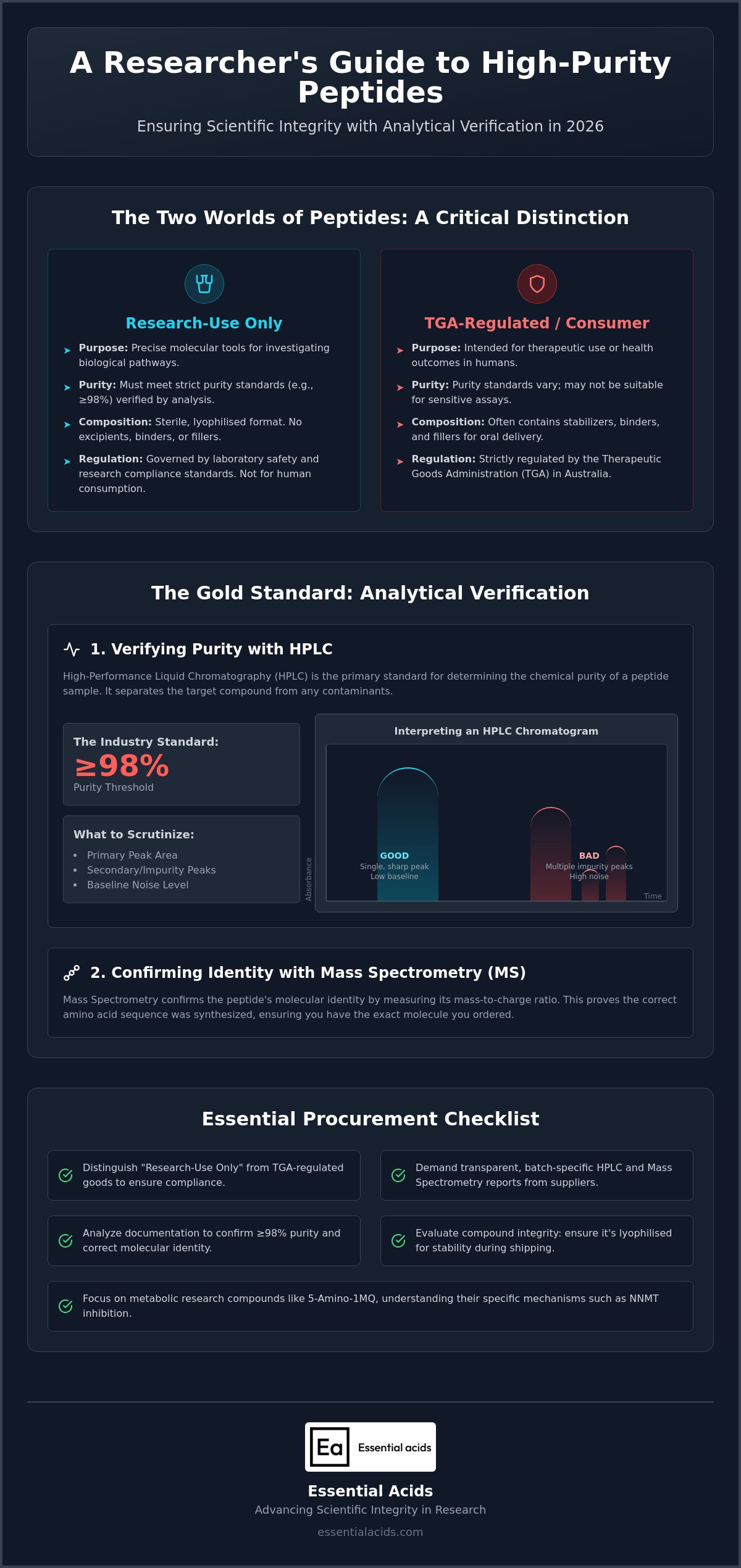
Research-grade peptides must adhere to strict molecular weight accuracy and sequence verification protocols. Professional high purity peptides for sale in this category are provided in a sterile, lyophilised format. This freeze-drying process ensures long-term stability and prevents degradation during national shipping across Australia. In contrast, consumer-grade oral peptides often contain binders and fillers that are unsuitable for rigorous laboratory protocols. These additives can interfere with cellular responses, leading to skewed results in metabolic research. Accuracy in the laboratory depends on the absence of these confounding variables.
Regulatory Framework for Research Chemicals in Australia
Understanding the legal landscape in Australia requires a clear distinction between clinical applications and non-therapeutic laboratory materials. Compliant sourcing is essential for both institutional and private research entities to maintain their standing and ensure safety. The regulatory environment in 2026 emphasizes the responsibility of the researcher to procure materials from suppliers that prioritize transparency and provide verifiable data. High-purity peptides are strictly intended for laboratory research and are not for human or animal consumption. This boundary is vital for maintaining the ethical and legal standards of the Australian scientific community.
Analytical Verification: Interpreting HPLC and Mass Spectrometry
In biochemical research, the integrity of a study depends on the precise composition of the reagents. While many vendors offer high purity peptides for sale, the absence of batch-specific data renders these claims unverifiable. High-Performance Liquid Chromatography (HPLC) serves as the primary analytical standard for determining chemical purity, whereas Mass Spectrometry (MS) is required to confirm the exact molecular identity of the synthesized sequence. Accuracy in these metrics is the difference between reproducible data and failed experiments.
How to Interpret an HPLC Chromatogram
Analyzing the peak area is the fundamental method for determining compound concentration versus impurities. The primary peak on the chromatogram represents the target peptide, while any secondary peaks indicate the presence of contaminants. The FDA guidance on peptide impurities provides a technical framework for characterizing these substances, emphasizing that even minor contaminants can alter experimental outcomes. For research-grade compounds, a purity threshold of ≥98% is the industry standard.
Identifying baseline noise is equally critical. A high noise floor suggests a manufacturing environment with poor contamination controls or residual reagents. Anything less than the 98% threshold introduces variables that may compromise metabolic or cellular ageing data. Researchers should scrutinize the integration table provided with the chromatogram to ensure the reported percentage aligns with the visual data presented in the report. This scrutiny ensures the compounds don't introduce non-specific binding or cellular toxicity into the assay.
Sequence Validation via Mass Spectrometry
Mass spectrometry measures the mass-to-charge ratio of the sample. Matching the observed molecular mass against the theoretical weight of the peptide is the only way to confirm you've received the correct compound. Mass spectrometry is the gold standard for peptide identification because it provides a definitive molecular fingerprint of the synthesized sequence, ensuring the correct amino acid chain has been successfully produced.
This process also identifies potential synthesis by-products, such as truncated sequences or residual solvents, which could interfere with cellular responses. When procuring high purity peptides for sale, the MS report must show a single, clear peak corresponding to the target mass. Any deviation in the mass profile suggests the compound is incorrect or has undergone significant degradation.
Relying on "representative" reports is a common pitfall in procurement. These outdated documents don't reflect the current batch's profile. Scientific integrity requires access to the exact data for the vial in your laboratory. You can review the analytical reports for our metabolic research compounds to see how these standards are applied to every batch without exception.
Molecular Profiles: 5-Amino-1MQ and Key Research Compounds
Selecting specific compounds for biochemical assays requires a granular understanding of their molecular profiles. In metabolic research, 5-Amino-1MQ has emerged as a critical tool for investigating the inhibition of nicotinamide N-methyltransferase (NNMT). This small molecule is utilized to study cellular energy metabolism and the potential modulation of adipocyte function. When procuring high purity peptides for sale, researchers must ensure the chemical structure aligns exactly with the intended biological pathway to avoid non-specific enzymatic interactions.
Metabolic Health and Cellular Ageing Compounds
The mechanism of 5-Amino-1MQ centers on its ability to block NNMT, an enzyme that plays a key role in energy homeostasis and systemic metabolism. Studies focused on metabolic signaling often incorporate this compound alongside others such as AOD-9604 and Retatrutide. AOD-9604 is investigated for its lipolytic effects without the growth-promoting properties of traditional growth hormone fragments. Retatrutide represents a multi-agonist approach, targeting GLP-1, GIP, and glucagon receptors to study complex metabolic responses within cellular models. Researchers investigating growth factor signaling should review the molecular profile of Ipamorelin for detailed data on ghrelin receptor agonism and its role in pituitary stimulation.
Bioregulatory and Signaling Peptides
Bioregulatory research often involves compounds like Epithalon and Thymalin. Epithalon is primarily used to investigate telomere length modulation and its relationship with cellular ageing, while Thymalin is studied for its potential to restore immune response signaling. These sequences require high-integrity synthesis to maintain their bioregulatory function. Technical profiles of copper-binding compounds are also essential for peptides for skin research, where the focus is on extracellular matrix remodeling and cellular repair mechanisms.
Protective signaling is another major area of investigation. BPC-157 and TB-500 (Thymosin Beta-4) are utilized to study cellular migration and angiogenic pathways. The role of BPC-157 in maintaining laboratory research standards is particularly significant in 2026, as its chemical stability in various environments makes it a versatile tool for diverse experimental designs. For neuroprotective research, the sequences of Semax and Selank are investigated for their ability to modulate neurotransmitter signaling and brain-derived neurotrophic factor (BDNF) expression. Procuring high purity peptides for sale ensures that these neuroprotective assays are not confounded by peptide fragments or synthesis residuals that could trigger unintended cellular toxicity.
Laboratory Procurement Best Practices for 2026
Procuring biochemical reagents for laboratory use requires a disciplined approach to quality assurance that extends beyond the initial purchase. In the Australian research sector, identifying high purity peptides for sale involves more than comparing unit costs; it necessitates a rigorous evaluation of the supplier's commitment to analytical transparency. Researchers must verify that compounds are handled with the same precision during transit and storage as they were during the initial synthesis phase. This ensures that the molecular integrity of the compound is preserved until the moment of reconstitution.
Evaluating Supplier Transparency
Marketing terms like "pharmaceutical grade" are often used loosely in the consumer marketplace to imply quality. In a laboratory setting, these descriptors are secondary to the analytical reality of batch-specific data. A reliable supplier must provide HPLC and Mass Spectrometry reports for the specific batch being procured rather than relying on generic or outdated documentation. This transparency allows the researcher to confirm that the compound's purity and identity match the experimental requirements exactly. You should review our technical guide to laboratory procurement for a detailed breakdown of these institutional standards.
Shipping and Handling of Research Compounds
Stability during national transit in 2026 is primarily achieved through lyophilisation. This freeze-drying process preserves the peptide's primary structure, allowing for stable transport across Australia's diverse climates without the immediate risk of degradation. Once delivered, compounds should be stored in a temperature-controlled laboratory environment to optimize shelf-life. While many lyophilised sequences remain stable at room temperature for brief periods, long-term storage typically requires temperatures of -20°C or lower to prevent any subtle structural changes. For specific temperature-sensitive sequences, cold-chain logistics may be required to maintain the required thermal profile from the facility to the laboratory bench.
The integrity of the research process depends on proper reconstitution protocols. This must be performed using sterile BAC Water to prevent microbial contamination and maintain compound stability during the assay period. Using non-sterile or improper solvents will lead to rapid degradation and invalid experimental data. Ethical procurement also requires a firm adherence to the research-use only mandate. High-purity chemicals are molecular tools for scientific investigation, and their procurement should be handled with the gravity that laboratory research demands. Maintaining these boundaries is essential for the continued integrity of the Australian scientific community.
Access the current inventory of verified research compounds to ensure your laboratory reagents meet these 2026 analytical standards.
Essential Acids: Advancing Scientific Integrity in Research
Essential Acids functions as a rigorous gatekeeper for the Australian scientific community, providing the high-integrity materials necessary for advanced biochemical investigation. Our primary aspirational statement, "Making better, normal," is grounded in the disciplined reality of laboratory precision. We recognize that the gravity of metabolic and neuroscience research requires compounds that perform with absolute predictability. By offering high purity peptides for sale that meet strict analytical benchmarks, we ensure that the quality of the compounds speaks for itself without the need for aggressive marketing tactics.
Maintaining regulatory compliance is a core value of our operation. Every compound in our inventory is strictly for research-use only, a boundary that reinforces our commitment to ethical scientific practice. This disciplined approach supports researchers in navigating the complexities of 2026 regulatory standards while maintaining the focus on their experimental objectives. Our role is to act as a reliable partner, providing the stable, verified reagents required to push the boundaries of human knowledge.
The Essential Acids Quality Assurance Protocol
Our quality assurance protocol is designed to eliminate the uncertainty often associated with the procurement of research chemicals. We implement standardised analytical testing for every batch of 5-Amino-1MQ and all other compounds in our extensive catalog. This process involves a meticulous verification of both molecular identity and chemical purity through HPLC and Mass Spectrometry. Transparency in the scientific supply chain is non-negotiable; therefore, we provide access to batch-specific analytical documentation for every procurement. This ensures that the material in your laboratory matches the data on the report with absolute fidelity.
Future-Proofing Your Research
As metabolic and neuroscience research continues to evolve in 2026, the variables within any experimental setup must be tightly controlled. Integrity is the most critical variable in this equation. Using reagents with verified purity profiles allows researchers to stay informed on molecular developments without the confounding effects of synthesis residuals or degraded sequences. By prioritizing analytical transparency today, you safeguard the reproducibility of your data for future peer review and institutional scrutiny. Precision is the foundation of every breakthrough, and we provide the tools to build that foundation with confidence.
View our catalog of high-purity research peptides to secure analytical-grade compounds for your next laboratory project.
Advancing Analytical Standards in 2026 Laboratory Research
Maintaining the integrity of biochemical research in Australia requires a steadfast commitment to analytical precision. The procurement of high purity peptides for sale is defined by the availability of batch-specific HPLC and Mass Spectrometry documentation. These reports ensure that molecular identity and purity thresholds are verified before any laboratory work begins. By distinguishing research-only compounds from consumer supplements, you maintain the rigorous standards necessary for metabolic and neuroscience investigations.
A specialized focus on sequences like 5-Amino-1MQ demands clinical-grade manufacturing protocols that prioritize transparency over marketing claims. Adhering to these procurement best practices secures the stability of your compounds and the reproducibility of your data. This disciplined approach to sourcing is the foundation for meaningful scientific advancement. It's the responsibility of the researcher to ensure every variable is accounted for at the molecular level.
Secure High-Purity Research Peptides for Your Laboratory to ensure your reagents meet the highest benchmarks of scientific integrity. We remain dedicated to supporting the precision of the laboratory environment through strictly regulated, data-backed materials.
Frequently Asked Questions
Are peptides for sale in Australia legal for research purposes?
Peptides are legal for research use in Australia when they are classified and sold as non-therapeutic laboratory materials. These compounds are not intended for human or veterinary administration and fall outside the TGA's therapeutic goods framework when used strictly for scientific investigation. It's the researcher's responsibility to ensure compliance with institutional and state regulations regarding the handling of research-grade chemicals within a controlled laboratory environment.
What is the difference between research-grade and pharmaceutical-grade peptides?
The primary difference lies in the regulatory classification and intended application. Research-grade peptides are synthesized for laboratory assays and biochemical studies, whereas pharmaceutical-grade versions are manufactured under cGMP standards for clinical human use. Research materials are delivered in their pure, lyophilised form without the stabilizers or excipients required for patient administration. This ensures that experimental data remains untainted by the presence of pharmacological additives.
How do I verify the purity of a peptide batch before purchasing?
Verification is achieved by reviewing batch-specific HPLC and Mass Spectrometry documentation provided by the supplier. When evaluating high purity peptides for sale, researchers should demand a current Certificate of Analysis that matches the specific lot number of the vial. This document must show a clear, dominant peak on the chromatogram and a molecular weight that aligns with the theoretical mass of the synthesized peptide sequence.
Why is 5-Amino-1MQ considered a significant compound in metabolic research?
5-Amino-1MQ is significant due to its specific role as a nicotinamide N-methyltransferase (NNMT) inhibitor. In metabolic research, NNMT is a key enzyme involved in energy homeostasis and systemic metabolism. By blocking this enzyme, researchers can study cellular energy expenditure and the modulation of metabolic pathways in adipocytes. This compound provides a targeted mechanism for investigating cellular ageing and metabolic signaling without influencing other methyltransferases.
Can research peptides be used for human or veterinary diagnosis?
No, research peptides cannot be used for any diagnostic, therapeutic, or clinical purposes in humans or animals. These materials are strictly for in vitro or laboratory research applications. Essential Acids maintains a firm policy that these compounds are not for human consumption. Any use outside of a controlled scientific setting is a violation of the research-only mandate and may carry significant regulatory and safety risks.
What should be included in a standard Certificate of Analysis (CoA)?
A standard Certificate of Analysis should include the batch number, the HPLC purity percentage, and the Mass Spectrometry profile. It must also list the theoretical molecular weight compared to the observed mass and specify the date the analysis was performed. Comprehensive documentation ensures the scientific integrity of the supply chain, allowing researchers to account for the exact chemical composition of their reagents before starting an assay.
How should lyophilised peptides be stored to maintain molecular stability?
Lyophilised peptides should be stored in a freezer at -20°C or -80°C to ensure long-term molecular stability. While freeze-dried compounds are relatively stable at room temperature during national transit across Australia, they are sensitive to moisture, light, and heat over time. Vials should remain tightly sealed and protected from light. Once reconstituted with BAC Water, the peptide's shelf life is significantly reduced, requiring constant refrigeration.
What is the role of HPLC in determining peptide purity?
HPLC determines purity by separating the target peptide from any synthesis by-products or contaminants. The process measures the peak area of the primary compound relative to any secondary peaks on the chromatogram. This quantitative analysis is the industry standard for verifying that a compound meets the ≥98% purity threshold. Without HPLC data, it's impossible to confirm the chemical concentration of high purity peptides for sale in the research market.
Legal Disclaimer
All products sold on this website are intended exclusively for laboratory research purposes and not for human or veterinary use, diagnosis, cure, treatment, or prevention of any disease or condition. None of the statements on this site have been reviewed or evaluated by the U.S. Food and Drug Administration (FDA) or comparable regulatory authorities. Purchasing or using these products for any unintended purpose, including human consumption, may violate federal or local laws and poses safety risks.