

The common assumption that the kpv peptide is merely a scaled-down version of alpha-MSH overlooks the specific molecular engineering that isolates its anti-inflammatory properties from melanotropic effects. Researchers frequently encounter the challenge of unreliable purity and opaque documentation when sourcing these tripeptides, which compromises the scientific integrity of laboratory data. We recognize that the gravity of biochemical research requires absolute transparency and batch-specific verification to ensure objective results.
This technical profile provides a rigorous examination of the Lysine-Proline-Valine sequence, focusing on its interaction with the MC1R signaling pathway and its role in inhibiting the NF-κB pathway. You'll gain a comprehensive understanding of how this tripeptide functions within cellular models and how it compares to other research-grade compounds. We also review the 2026 regulatory landscape, specifically the April 23, 2026, FDA decision to remove KPV from the Category 2 restricted list. This overview establishes a foundation for making better, normal, through precise analytical inquiry into high-purity research materials.
Key Takeaways
- Differentiate the tripeptide's 3-amino acid structure from the 13-amino acid sequence of alpha-MSH to understand its non-melanotropic functional divergence.
- Evaluate the molecular mechanisms through which the kpv peptide modulates NF-kappaB signaling and interacts with MC1R in cellular inflammation models.
- Review the 2026 regulatory updates and the technical requirements for HPLC and Mass Spectrometry to verify the identity of analytical grade research compounds.
- Gain insight into the investigational use of Lysine-Proline-Valine for gut health research, specifically regarding mucosal responses and inflammatory pathways.
- Establish rigorous procurement standards to secure batch-specific, high-purity material, ensuring the validity and reproducibility of laboratory research data.
Molecular Profile: Understanding the KPV Tripeptide
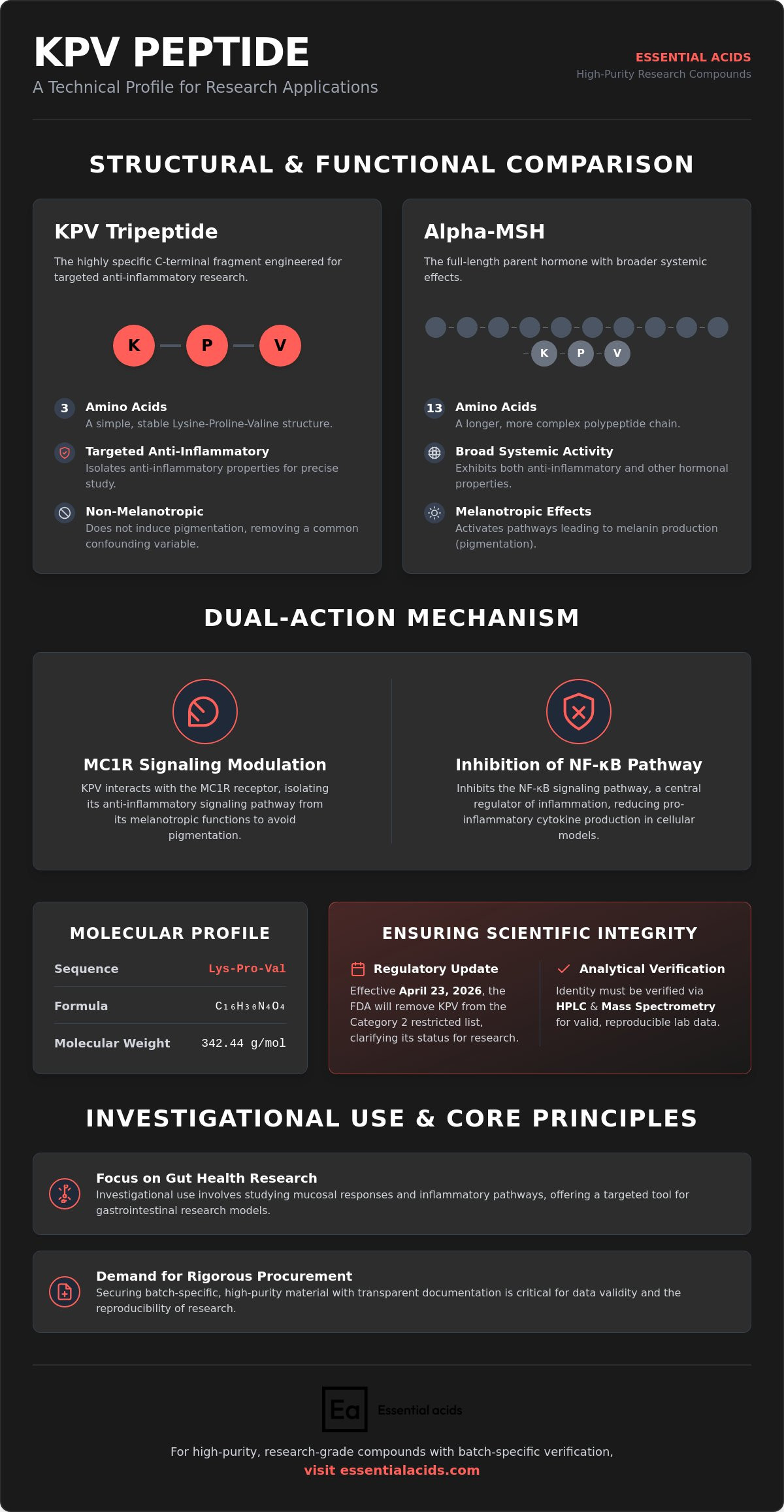
The kpv peptide is a specialized tripeptide consisting of three specific amino acids: Lysine (K), Proline (P), and Valine (V). Biochemical research identifies it as the C-terminal fragment of the alpha-Melanocyte-Stimulating Hormone (alpha-MSH). While alpha-MSH is a larger 13-amino acid chain primarily known for its role in melanogenesis, KPV represents a truncated sequence that retains potent biological signaling properties without the systemic melanotropic effects associated with the parent molecule. For researchers, this distinction is critical for isolating specific anti-inflammatory pathways in laboratory models. This KPV tripeptide overview highlights its structural simplicity, which facilitates high-purity synthesis and predictable analytical verification through HPLC and Mass Spectrometry.
- Chemical Formula: C16H30N4O4
- Molecular Weight: 342.44 g/mol
- Sequence: Lys-Pro-Val
- Terminal Structure: H-Lys-Pro-Val-OH
The C-terminal fragment's significance lies in its ability to mimic the anti-inflammatory domain of alpha-MSH. By excluding the central sequence responsible for pigment production, KPV serves as a highly specific tool. It allows for the exploration of non-melanotropic pathways, particularly those involving the modulation of inflammatory cytokines within cellular environments.
The Sequence of Lysine-Proline-Valine
The specific arrangement of Lysine, Proline, and Valine determines the peptide's chemical behavior and stability. Lysine provides a positive charge at physiological pH, which is often a key factor in protein-peptide interactions. Proline, a cyclic amino acid, introduces a structural constraint that limits the flexibility of the peptide backbone. This kink helps the molecule resist rapid enzymatic degradation by proteases, making it more stable in various research environments than longer, more flexible chains. Valine, a branched-chain amino acid, contributes hydrophobic properties to the C-terminus. This hydrophobicity is essential for the peptide's ability to interact with lipid environments and specific receptor pockets within cellular membranes.
Evolution from Alpha-MSH
KPV was isolated during research into the functional domains of alpha-MSH. Early studies identified that the full 13-amino acid sequence wasn't required for all its biological activities. Specifically, the C-terminal tripeptide fragment was found to mediate anti-inflammatory responses independently. This discovery marked a significant shift in peptide research. Scientists moved away from systemic melanotropic studies, which were often complicated by pigmentation changes, toward targeted tripeptide research. By focusing on the kpv peptide, laboratory applications can investigate cellular signaling pathways with greater precision and fewer confounding variables. It's a refined approach to understanding how small molecular fragments can exert significant biological influence without the complexity of a full-length hormone.
Mechanisms of Action in Controlled Research Environments
The kpv peptide functions as a precise signaling molecule in laboratory environments, offering a streamlined mechanism for investigating inflammatory modulation. Unlike larger peptides that may activate multiple receptors across various systems, KPV's simplified structure allows for more isolated observations of cellular behavior. This focus is particularly valuable in in vitro studies where the objective is to understand how specific tripeptide sequences interact with cellular receptors without triggering systemic hormonal cascades. It's an ideal tool for researchers who require high-integrity data from isolated cell lines.
MC1R Signaling and Cellular Response
Central to its mechanism is the interaction with the Melanocortin 1 Receptor (MC1R). While alpha-MSH is the primary ligand for this receptor, it's clear KPV exhibits a unique binding profile that avoids the induction of pigmentation. This allows researchers to isolate the receptor's anti-inflammatory signaling from its melanotropic functions. The downstream effects typically involve the modulation of intracellular cAMP levels, which serves as a critical regulator of the cell's immune status. By altering these secondary messenger concentrations, KPV provides a window into how small peptides can influence complex intracellular environments without the complications of systemic pigment changes.
Inhibition of NF-kappaB Pathways
The most documented mechanism in current research is the modulation of the NF-kappaB pathway. This pathway acts as a master switch for the inflammatory response. In controlled models, the kpv peptide has been shown to enter the cell and interfere with the translocation of the p65 subunit. By blocking this subunit from entering the nucleus, the tripeptide prevents the binding of NF-kappaB to DNA, thereby halting the transcription of inflammatory genes. NF-kappaB inhibition in kpv peptide research is defined as the targeted interruption of p65 translocation to suppress the synthesis of pro-inflammatory mediators.
Current laboratory investigations also examine KPV's influence on the expression of pro-inflammatory cytokines such as IL-1beta, IL-6, and TNF-alpha. By suppressing these mediators, the peptide helps researchers model the stabilization of cellular environments under stress. Its role in antimicrobial peptide research is equally significant; KPV's often studied for its ability to enhance the endogenous defense mechanisms of mucosal surfaces. This makes it a primary tool for gut health research, where maintaining mucosal integrity is a key metric. For researchers requiring verified compounds to explore these pathways, securing analytical grade Lysine-Proline-Valine ensures that experimental variables remain tightly controlled.
Comparative Analysis: KPV vs. Alpha-MSH
The distinction between the kpv peptide and its parent molecule, alpha-Melanocyte-Stimulating Hormone (alpha-MSH), is defined by structural truncation and functional specialization. While alpha-MSH is a tridecapeptide consisting of 13 amino acids, KPV is a tripeptide representing only the C-terminal fragment. This reduction in molecular size fundamentally alters the compound's interaction with the melanocortin system. Alpha-MSH acts as a non-selective agonist across multiple melanocortin receptors, inducing a broad range of physiological responses including pigmentation. In contrast, KPV exhibits a more focused utility, primarily serving as a tool for investigating localized inflammatory pathways without the systemic complexities associated with the full-length hormone.
Melanotropic Activity and Research Limitations
The primary research limitation of alpha-MSH in inflammatory studies is its potent melanotropic activity. The core sequence of alpha-MSH, specifically the His-Phe-Arg-Trp motif, is responsible for binding to MC1R to stimulate melanogenesis. Because the kpv peptide lacks this core sequence, it doesn't induce pigment production in cellular models. This absence makes KPV a cleaner analytical tool for researchers who need to observe anti-inflammatory signaling in isolation. Comparative binding affinity studies indicate that while alpha-MSH has a higher affinity for inducing pigment, KPV maintains the ability to modulate NF-kappaB pathways. This divergence allows for the study of skin or mucosal inflammation without the confounding variable of induced tanning or melanocyte proliferation.
Structural Stability and Half-Life
Structural stability is another area of significant divergence. Longer peptide chains like alpha-MSH are often more susceptible to enzymatic cleavage and rapid degradation in laboratory solutions. The tripeptide structure of Lysine-Proline-Valine offers a more robust profile for specific in vitro applications. Tripeptides generally demonstrate higher resistance to specific proteases compared to their longer precursors. In research settings, KPV is typically supplied as a lyophilized powder with a verified purity of 99% or higher. Once reconstituted, its stability depends heavily on the buffer used and the storage temperature. Maintaining molecular integrity requires strict adherence to laboratory protocols, such as avoiding repeated freeze-thaw cycles. The smaller molecular weight also facilitates easier transport across certain cellular membranes in research models, providing a logistical advantage over the larger 13-amino acid hormone.
Investigational Applications in Laboratory Research
The utility of the kpv peptide in contemporary research models is defined by its versatile signaling capabilities across multiple tissue types. While its molecular simplicity was established in previous sections, its practical application in the lab focuses on stabilizing cellular environments under induced stress. Researchers utilize KPV to model complex biological responses in gut health, dermatology, and systemic inflammation. The tripeptide's lack of melanotropic activity allows for these investigations to proceed without the confounding pigmentary variables often encountered with other melanocortin agonists.
Gastrointestinal and Mucosal Research
In gastrointestinal research, KPV is a primary tool for investigating mucosal inflammation and IBD-like responses in vitro. A specific point of technical interest is the transport mechanism of the tripeptide. Studies indicate that KPV is transported into intestinal epithelial cells via the PepT1 transporter. Because PepT1 expression is often upregulated in inflammatory states, KPV serves as a highly efficient model for targeted cellular uptake during mucosal stress. Laboratory assays also focus on the peptide's ability to prevent bacterial translocation by maintaining the integrity of tight junction proteins. This research is critical for understanding the mechanics of the intestinal barrier and its response to pathological stimuli.
Beyond the gut, the kpv peptide is frequently employed in peptides for skin research to observe cellular migration and tissue repair. Wound healing assays often measure the rate at which keratinocytes and fibroblasts migrate across a denuded area in the presence of the tripeptide. These models help quantify the peptide's influence on structural remodeling and the inflammatory phase of repair. For more complex multi-peptide studies, researchers frequently combine KPV with BPC-157 5mg to observe potential synergistic effects on tissue recovery and angiogenic signaling in controlled environments.
Systemic Inflammation and Cytokine Research
The impact of KPV on pro-inflammatory cytokine expression remains a central pillar of its investigational use. In various cell culture models, researchers monitor changes in the levels of IL-1beta, IL-6, and TNF-alpha. By quantifying these shifts, scientists can map the tripeptide's effectiveness in modulating the systemic inflammatory cascade. There is also a growing interest in neuroinflammation research, where KPV's ability to influence glial cell activity is under scrutiny. This work is often viewed alongside research into the Semax Peptide to provide a broader context for how various peptide sequences interact with neurological signaling pathways. Achieving reproducible data in these sensitive models requires the use of high-purity, analytical-grade material. Researchers can secure batch-verified Lysine-Proline-Valine to ensure the integrity of their experimental outcomes.
Procurement Standards and Analytical Verification
Scientific integrity in laboratory research relies on the absolute precision of the compounds used. When sourcing the kpv peptide, researchers must prioritize analytical verification to ensure the absence of contaminants that could skew experimental data. High-purity material isn't just a preference; it's a requirement for the reproducibility of results in cellular inflammation and mucosal integrity models. Procurement should always be accompanied by batch-specific documentation that confirms the molecular identity and purity of the tripeptide through rigorous testing protocols.
HPLC (High-Performance Liquid Chromatography) serves as the primary standard for determining purity levels. This process measures the concentration of the target tripeptide relative to any secondary peaks or impurities. Mass Spectrometry (MS) follows to confirm the molecular weight, verifying that the synthesized sequence is exactly Lysine-Proline-Valine. A compound's identity remains speculative without these two tests. Researchers shouldn't accept generic data sheets. They need verified reports that correspond directly to the specific batch in their inventory.
Interpreting HPLC and MS Reports
A Certificate of Analysis (CoA) provides the technical transparency required for high-level research. When reviewing a CoA, focus on the purity percentage; reputable suppliers maintain a standard of 99% or higher. It's also vital to examine residual solvent limits. High levels of trifluoroacetic acid (TFA) or other solvents used during synthesis can interfere with sensitive cellular assays, leading to false positives or unintended cytotoxic effects. Batch-specific documentation ensures that the kpv peptide used in a 2026 study meets the same rigorous standards as previous benchmarks, maintaining the continuity of scientific inquiry.
Laboratory Storage and Handling
Stability is paramount for maintaining the molecular integrity of the tripeptide sequence. Lyophilized powder is generally stable at room temperature for short durations, but long-term preservation requires storage at -20°C. Once the peptide is reconstituted, its half-life decreases, and it becomes more susceptible to enzymatic degradation or bacterial growth. Researchers should use sterile bacteriostatic water or phosphate-buffered saline for reconstitution and store the resulting solution at 4°C. Avoiding repeated freeze-thaw cycles is essential to prevent peptide shearing. For those establishing new laboratory protocols, our guide on buying research peptides in Australia provides broader context on procurement standards.
Legal compliance remains a critical component of laboratory management. The "research-use only" designation is a strict boundary that defines the ethical and regulatory framework for these compounds. These materials aren't approved for human consumption and are intended solely for in vitro and animal models. Maintaining this distinction is necessary for the continued advancement of peptide science and ensures that research focus remains on the biochemical potential of these sequences within controlled environments.
Advancing Cellular Research with Precision Tripeptides
The kpv peptide represents a significant evolution in laboratory research, offering a refined tool for investigating mucosal and inflammatory pathways without the systemic interference of melanogenesis. By isolating the C-terminal fragment of alpha-MSH, researchers can observe localized cellular responses with greater clarity and reproducibility. The transition toward stricter analytical verification in 2026 ensures that experimental data remains grounded in verified molecular identity and batch-specific purity. These advancements allow for a more disciplined inquiry into the mechanics of cellular signaling and tissue repair.
Establishing a baseline for objective research starts with the quality of the tripeptide sequence. As the scientific community moves toward more specialized signaling models, the role of high-integrity compounds becomes increasingly vital. Every batch provided is supported by comprehensive documentation to ensure that your laboratory protocols remain uninterrupted by impurities or inconsistent synthesis. Maintaining these rigorous standards is essential for the pursuit of scientific integrity. Researchers are invited to View Analytical Grade KPV and Research Compounds to secure high-purity materials that adhere to the highest laboratory standards. We look forward to supporting the next phase of your investigational inquiry.
Frequently Asked Questions
Is KPV peptide the same as alpha-MSH?
No, KPV is not identical to alpha-MSH. It's a truncated tripeptide fragment representing only the C-terminal end of the 13-amino acid alpha-MSH chain. While it retains the anti-inflammatory signaling properties of the parent molecule, it lacks the specific amino acid sequence required to trigger melanogenesis. This distinction is vital for researchers who need to observe cellular pathways without the systemic pigmentary effects of the full hormone.
What is the recommended storage temperature for lyophilized KPV?
Lyophilized KPV should be stored at -20°C to ensure long-term molecular stability. While the freeze-dried powder can withstand room temperature for short durations during transit, a consistent deep-freeze environment is necessary to prevent degradation. Maintaining these precise conditions is a core requirement for preserving the scientific integrity of the compound before it's introduced into a controlled laboratory protocol.
Can KPV be used in human clinical trials?
No human clinical trials have been conducted to validate KPV for medical treatment or safety in humans. The material is strictly for research-use only and is intended exclusively for in vitro models or animal studies. Any application outside of these regulated laboratory environments falls outside the established ethical and legal framework for high-purity research compounds. Adherence to these rules is mandatory for all procurement.
How does KPV interact with the MC1 receptor?
The kpv peptide binds to the Melanocortin 1 Receptor (MC1R) but bypasses the melanotropic core sequence. This interaction primarily modulates intracellular cAMP levels, which acts as a secondary messenger to influence the cell's inflammatory status. By targeting this receptor without inducing pigment production, the tripeptide provides a unique window into non-melanotropic signaling pathways within various cellular environments.
What solvents are typically used for KPV reconstitution in labs?
Sterile bacteriostatic water or phosphate-buffered saline (PBS) are the primary solvents used for the reconstitution of KPV. These liquids allow the peptide to form a stable, clear solution that's compatible with most laboratory assays. The choice between these solvents often depends on the specific requirements of the cellular model being studied and the necessary pH balance for the experimental environment.
What is the purity standard for analytical grade KPV?
Analytical grade KPV must maintain a purity level of 99% or higher, as verified by High-Performance Liquid Chromatography (HPLC). This rigorous standard ensures that no residual solvents or synthesis byproducts interfere with sensitive research data. Every batch of the kpv peptide should be accompanied by batch-specific Mass Spectrometry reports to confirm that the molecular weight matches the Lysine-Proline-Valine sequence exactly.
Is KPV stable in bacteriostatic water for research?
KPV demonstrates adequate stability in bacteriostatic water when the reconstituted solution is stored at 4°C. However, all peptides are more vulnerable to enzymatic cleavage once they're in a liquid state compared to their lyophilized form. Researchers should avoid repeated freeze-thaw cycles and only reconstitute the amount required for immediate protocols to ensure the tripeptide remains stable throughout the study period.
Does KPV have melanotropic (tanning) effects in research models?
KPV does not produce melanotropic or tanning effects in research models. It lacks the His-Phe-Arg-Trp motif, which is the specific molecular sequence responsible for stimulating melanin production via MC1R activation. This absence of tanning activity is what makes the tripeptide a preferred tool for investigating anti-inflammatory mechanisms in skin and mucosal research, as it eliminates pigmentary interference from the experimental results.
Legal Disclaimer
All products sold on this website are intended exclusively for laboratory research purposes and not for human or veterinary use, diagnosis, cure, treatment, or prevention of any disease or condition. None of the statements on this site have been reviewed or evaluated by the U.S. Food and Drug Administration (FDA) or comparable regulatory authorities. Purchasing or using these products for any unintended purpose, including human consumption, may violate federal or local laws and poses safety risks.