

The semax peptide is far more than a basic nootropic; it is a sophisticated heptapeptide that functions as a multimodal genomic modulator within the central nervous system. Achieving consistent results in neurocognitive research requires a deep understanding of its Met-Glu-His-Phe-Pro-Gly-Pro sequence and its specific interaction with Brain-Derived Neurotrophic Factor. You likely recognize the difficulty of sourcing high-purity compounds when analytical standards remain unstandardized across the industry. This article clarifies the biochemical mechanisms of Semax, providing the technical clarity required for rigorous laboratory applications.
We will examine the molecular profile of this ACTH analog, discuss current storage and reconstitution protocols, and review the significant regulatory changes occurring in 2026. Following the FDA’s removal of Semax from the Category 2 list on April 15, 2026, the shift toward standardized procurement has never been more critical. By the end of this overview, you'll possess a comprehensive framework for integrating this compound into your research domains while maintaining the highest levels of scientific integrity. This is how we move toward making better, normal.
Key Takeaways
- Understand the molecular architecture of the semax peptide, a synthetic analog of the ACTH 4-10 fragment designed for metabolic stability in laboratory settings.
- Analyze the biochemical pathways through which this heptapeptide stimulates Brain-Derived Neurotrophic Factor (BDNF) and modulates TrkB receptors to support neural plasticity.
- Distinguish between the stimulating properties of Semax and the anxiolytic profile of Selank to select the appropriate compound for specific neurocognitive research objectives.
- Establish a rigorous protocol for laboratory procurement by prioritizing batch-specific HPLC and Mass Spectrometry verification to ensure compound integrity and analytical purity.
What is Semax Peptide? Molecular Origin and Structure
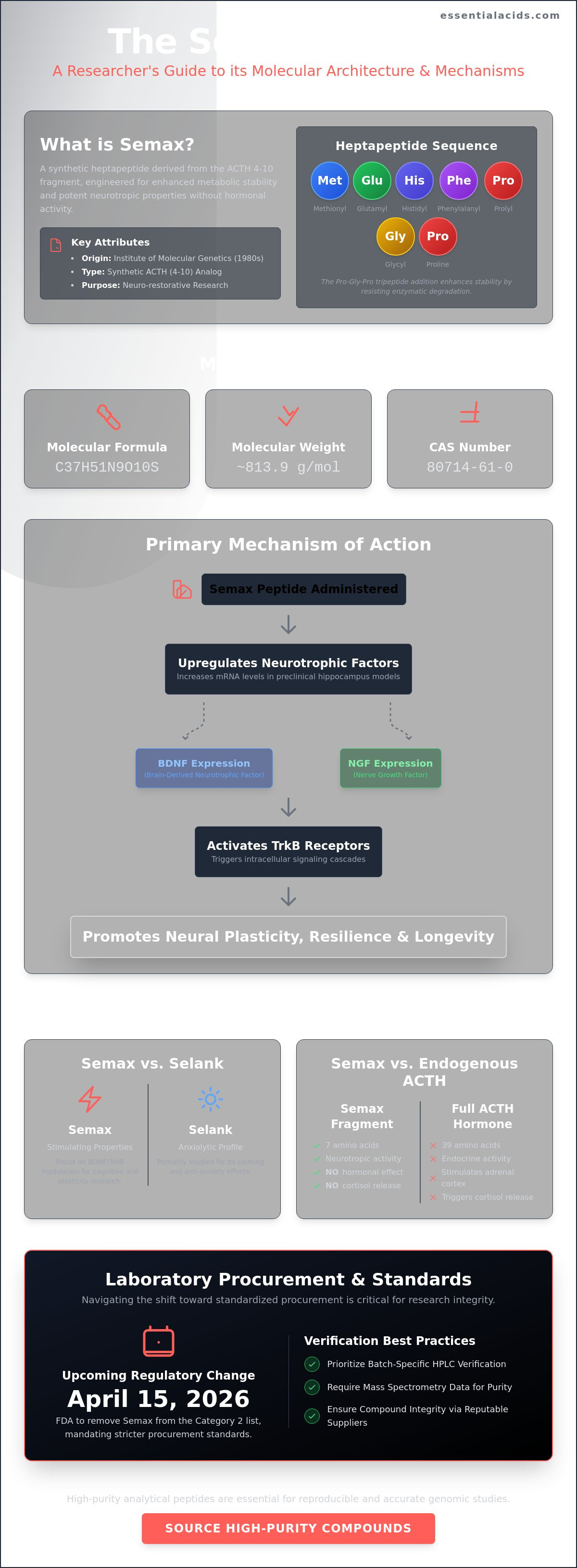
Semax is a synthetic heptapeptide derived from the adrenocorticotropic hormone (ACTH) fragment 4-10. It was originally synthesized by the Institute of Molecular Genetics of the Russian Academy of Sciences during the 1980s to facilitate neuro-restorative research following ischemic events. While its lineage connects it to the melanocortin system, the semax peptide is structurally modified to eliminate hormonal activity while enhancing its neurotropic properties. Its molecular formula is C37H51N9O10S, and it consists of the amino acid sequence L-Methionyl-L-glutamyl-L-histidyl-L-phenylalanyl-L-prolyl-glycyl-L-proline. This specific arrangement was engineered to address the rapid degradation typically observed with endogenous neuropeptides in laboratory models. For a broader context on its development and pharmaceutical history, this Semax peptide overview provides additional background on its clinical trajectory.
The Heptapeptide Architecture
The stability of Semax is largely attributed to the addition of the Pro-Gly-Pro tripeptide to the C-terminus of the ACTH 4-7 fragment. This modification creates a barrier against proteolytic enzymes, significantly extending its half-life compared to the original ACTH 4-10 sequence. By utilizing only L-amino acids, the molecule maintains high biological affinity while resisting the enzymatic cleavage that usually occurs within minutes in the bloodstream or neural tissues. This structural reinforcement ensures that the peptide remains active long enough to interact with target neural receptors during analytical procedures. The compound has a molecular weight of approximately 813.9 g/mol and is identified by CAS number 80714-61-0 for laboratory identification.
Semax vs. Endogenous ACTH
It's vital for researchers to distinguish between the full-length ACTH hormone and this specific fragment. Endogenous ACTH is a 39-amino acid polypeptide responsible for stimulating the adrenal cortex to produce corticosteroids. In contrast, the semax peptide lacks the amino acid sequences required for binding to MC2 receptors, which means it doesn't trigger the systemic stress response or cortisol release. This non-hormonal profile allows for the isolated study of neurocognitive pathways without the confounding variables of adrenal activation. Maintaining this distinction is essential for preserving the integrity of metabolic research and ensuring that observed results are attributed solely to neurotropic modulation rather than systemic hormonal shifts. The peptide acts as a pure neuro-modulator, focusing its activity on the brain rather than the endocrine system.
Mechanisms of Action: BDNF and Genomic Modulation
The semax peptide operates through a complex interplay of genomic modulation and neurotrophic signaling. Unlike simpler compounds that target isolated neurotransmitter systems, Semax exerts a multimodal influence on the central nervous system by altering the transcriptional activity of numerous genes. Its primary mechanism involves the upregulation of Brain-Derived Neurotrophic Factor (BDNF) and the subsequent activation of tropomyosin receptor kinase B (TrkB) pathways. This interaction is fundamental to synaptic plasticity and the maintenance of neural integrity in laboratory models. Researchers focus on these pathways to understand how the peptide supports the survival and functional differentiation of neurons under various environmental stressors. This genomic modulation suggests that the peptide doesn't merely provide a temporary stimulus but rather shifts the cellular environment toward a state of heightened resilience and adaptability.
Upregulation of Neurotrophic Factors
Quantitative analysis in preclinical hippocampus models demonstrates a significant increase in the mRNA levels of neurotrophins following the introduction of Semax. Studies have documented that both Nerve Growth Factor (NGF) and BDNF expression levels rise substantially compared to baseline control groups. This upregulation isn't transient; it represents a sustained shift in the neurotrophic environment that facilitates research into long-term potentiation and memory formation. The activation of the TrkB receptor serves as a critical gateway for these effects, triggering intracellular signaling cascades that promote cellular longevity. When sourcing compounds for such sensitive genomic studies, scientists often prioritize high-purity analytical peptides to ensure that observed transcriptional changes are a direct result of the heptapeptide rather than contaminants. The integrity of the data depends on the precision of the molecular sequence, as even minor impurities can disrupt the delicate balance of neurotrophin expression in hippocampal tissues.
Transcriptional Influence on Ischemic Response
The genomic impact of Semax extends into the regulation of the immune and vascular systems, particularly during oxidative stress. Transcriptional analysis reveals that the peptide influences the expression of over 50 genes involved in the inflammatory response and leukocyte chemotaxis. In models of focal ischemia, Semax has been shown to modulate Vascular Endothelial Growth Factor (VEGF) expression, which is critical for investigating angiogenesis and vascular permeability. The peptide’s ability to influence 50+ genes involved in the immune response allows it to suppress pro-inflammatory cytokines while promoting factors that support tissue repair. By stabilizing the mRNA levels for these neurotrophins and their respective receptors, the peptide provides a stable framework for analyzing the molecular foundations of neuroprotection. This genomic flexibility allows the compound to adapt its influence based on the physiological state of the tissue, making it a unique tool for metabolic and cellular research. It's this capacity for wide-scale genomic regulation that distinguishes Semax from traditional neuroprotective agents, offering a more comprehensive model for studying systemic responses to neural injury.
Primary Domains of Semax Research and Analysis
Research involving the semax peptide spans several distinct biological domains, primarily focusing on the modulation of cognitive and protective pathways within the central nervous system. Unlike traditional neuro-stimulants that rely on direct catecholamine release, this compound is studied for its ability to stabilize neural biomarkers under conditions of physiological stress. Current analytical models prioritize its influence on attention, memory consolidation, and cellular survival. These investigations are rooted in the peptide's multimodal capacity to interact with both the immune and nervous systems, providing a versatile framework for laboratory study. By maintaining a strict focus on "research-use only" applications, scientists can isolate the specific metabolic effects of the heptapeptide without the confounding variables of clinical use.
Cognitive Enhancement and Memory Formation
In cognitive research, the peptide is frequently utilized to investigate task performance under high cognitive load. Preclinical studies often focus on memory consolidation and long-term potentiation (LTP), which are the fundamental cellular mechanisms underlying learning. Researchers observe processing speed and error reduction in task-based models to quantify the compound's impact on neural efficiency. These observations suggest a shift in how neural networks manage information during periods of intense mental demand. For researchers expanding their laboratory catalog, identifying high-integrity sources for peptides for sale is a critical step in ensuring the reproducibility of these cognitive models. Scientific integrity depends on the use of verified compounds that meet strict analytical standards.
Neuroprotective and Ischemic Research
Neuroprotection models represent another primary domain of analysis, particularly concerning survival rates in oxidative stress environments. The semax peptide is widely employed in stroke recovery research to examine the inhibition of the ischemic cascade, a sequence of events that leads to secondary neuronal death. In-vitro studies demonstrate its potential to reduce glutamate excitotoxicity, a process where excessive neurotransmitter release causes cellular damage. By mitigating this excitotoxic response, the peptide allows for a deeper investigation into chronic neurodegenerative pathways and the preservation of neural tissue. Additionally, its anxiolytic-like activity is assessed in stress resilience models, where researchers look for improvements in adaptive behavior without the sedative markers typical of traditional anxiolytics. This unique profile makes it a valuable tool for studying the intersection of stress response and neuro-restoration, moving the field closer to making better, normal through precise molecular intervention.
Comparative Analysis: Semax vs. Selank in Research
The structural divergence between Semax and Selank defines their distinct roles in neurocognitive research. While the semax peptide is a heptapeptide derived from the ACTH 4-10 fragment, Selank is a synthetic analog of the naturally occurring tetrapeptide tuftsin. Both compounds were developed with a C-terminal Pro-Gly-Pro sequence to enhance enzymatic resistance, but their primary research focus remains polarized. Semax is predominantly utilized for its stimulating and nootropic properties, focusing on the upregulation of neurotrophins like BDNF. In contrast, Selank is investigated for its anxiolytic-like stabilization and its ability to modulate the GABAergic system without the sedative effects associated with traditional benzodiazepines. Understanding these differences is essential for researchers designing protocols that target specific metabolic or behavioral outcomes.
Metabolic pathways for both peptides show high resistance to proteolytic degradation due to their stabilized sequences. This structural integrity allows for extended interaction with target receptors in laboratory models. While Semax influences the melanocortin system and neurotrophic signaling, Selank demonstrates a stronger affinity for modulating serotonin metabolism and immune response markers. These distinct pathways mean that the compounds aren't interchangeable; rather, they serve as specialized tools for isolating different aspects of neural plasticity and stress adaptation. Researchers can procure high-purity Semax to ensure analytical consistency when investigating these complex biological interactions.
Contrasting the Nootropic and Anxiolytic Profiles
Semax is favored in research environments focusing on attention, memory consolidation, and processing speed under high cognitive load. Its affinity for melanocortin receptors provides a unique pathway for cognitive stimulation that doesn't rely on direct catecholamine release. Selank research typically centers on stress response models where emotional stability and anxiolysis are the primary variables. By differentiating between the excitatory-like genomic modulation of Semax and the regulatory modulation of Selank, scientists can more accurately select the compound that aligns with their specific hypothesis. This precision is vital for maintaining scientific integrity and ensuring that observed results are attributed to the correct biochemical mechanism.
Complementary Research Applications
Multimodal behavioral research models often utilize both peptides to observe complex neural interactions. Combined administration in preclinical assays allows for the study of how cognitive enhancement and stress resilience interact at a cellular level. For example, researchers may investigate how the neurotrophic support provided by the semax peptide is influenced by the anxiolytic stabilization of Selank during periods of prolonged oxidative stress. This dual-peptide approach provides a more comprehensive view of neural network adaptability. Scientists exploring these synergistic effects may also find value in reviewing Tesamorelin research applications to understand how growth hormone-related neurogenesis complements neuropeptide activity. Integrating multiple compounds into a single model requires rigorous batch-specific verification to ensure that each component meets high-purity standards, ultimately supporting the brand's goal of making better, normal through disciplined laboratory practice.
Laboratory Procurement: Standards for Semax in 2026
Procurement of the semax peptide requires a rigorous adherence to analytical standards to ensure the reproducibility of neurocognitive data. In the current 2026 research environment, the reliance on generic technical data is insufficient for high-level laboratory applications. Scientific integrity is maintained only through the acquisition of batch-specific documentation that verifies the molecular identity and purity of each compound. Researchers must prioritize suppliers that provide comprehensive transparency regarding their synthesis and filtration processes. This disciplined approach to sourcing ensures that experimental variables are minimized, allowing the quality of the compounds to speak for itself within the laboratory setting.
Verifying Peptide Purity and Integrity
For analytical grade research, a purity threshold of ≥99% is established as the industry standard. This level of refinement is verified through High-Performance Liquid Chromatography (HPLC) and Mass Spectrometry, which together confirm both the concentration and the exact molecular weight of the heptapeptide. When reviewing a chromatogram, researchers should identify a single, sharp peak representing the target molecule; any secondary peaks or broad "shoulders" indicate the presence of synthesis byproducts or degradation fragments. Identifying these impurities is critical, as even trace amounts of truncated sequences can interfere with BDNF upregulation assays. By upholding these high-integrity procurement standards, laboratories align with the philosophical commitment of "Making better, normal," ensuring that research foundations are built on verified data rather than marketing claims.
Reconstitution and Handling Protocols
The stability of the semax peptide is highly dependent on its physical state and environmental exposure. It's typically supplied as a lyophilized (freeze-dried) powder, which offers the greatest metabolic stability for long-term storage. Standard laboratory practices dictate that lyophilized vials be stored at -20°C to prevent deamidation and peptide cleavage. Once the compound is reconstituted using a sterile diluent, it must be maintained at 2-8°C and used within a specified timeframe to avoid degradation. Mechanical agitation during reconstitution should be avoided to prevent the denaturation of the delicate heptapeptide chain.
Strict adherence to "Research-Use Only" (RUO) protocols is mandatory for all procurement and handling within Australian laboratories. These compounds are strictly intended for laboratory research and are not for human or veterinary use. The formal, detached perspective maintained in these safety sections reflects a deep commitment to regulatory compliance and laboratory safety. This structural contrast between efficient procurement and rigorous protective language ensures that every researcher understands the boundaries of analytical use.
Advancing Neurocognitive Research Integrity in 2026
The semax peptide serves as a critical instrument for researchers investigating the complex intersections of neural plasticity and genomic modulation. By understanding its specific ACTH-derived structure and its capacity to upregulate Brain-Derived Neurotrophic Factor, scientists can establish more precise models for cognitive and neuroprotective study. Maintaining scientific integrity requires a transition from generic compounds to high-purity, analytical-grade materials that provide consistent results across all research domains. This disciplined approach ensures that every observation is rooted in the quality of the molecule itself rather than environmental variables.
Essential Acids facilitates this rigorous standard by providing batch-specific HPLC and Mass Spectrometry reports for every compound, ensuring that your laboratory receives only verified, high-purity lyophilized materials. Our secure, Australia-wide fulfillment system is designed to support the logistical needs of modern scientific institutions while adhering to strict research-use only protocols. By prioritizing technical transparency and analytical precision, we enable researchers to push the boundaries of what's possible in cellular and metabolic science. View Analytical Grade Semax for Research to secure high-integrity compounds for your next investigation. Together, we move closer toward making better, normal.
Frequently Asked Questions
What is the primary mechanism of action for the Semax peptide?
The primary mechanism of action for the semax peptide involves the significant upregulation of Brain-Derived Neurotrophic Factor (BDNF) and Nerve Growth Factor (NGF) within neural tissues. This interaction facilitates the activation of TrkB receptors, which are essential for investigating synaptic plasticity and neuronal survival. Beyond neurotrophin expression, the compound modulates the transcription of over 50 genes involved in immune and vascular responses during oxidative stress. These genomic shifts distinguish it from traditional neuro-stimulants.
How does Semax differ from the ACTH hormone?
Semax differs from the full-length adrenocorticotropic hormone (ACTH) by its specific 4-10 fragment derivation and the absence of steroidogenic activity. While endogenous ACTH consists of 39 amino acids and stimulates cortisol release via MC2 receptors, Semax is a modified heptapeptide that lacks these hormonal sequences. This allows researchers to isolate neurotropic effects without the confounding variables of adrenal activation. It's a non-hormonal analog specifically engineered for metabolic stability in laboratory research environments.
What is the recommended storage temperature for lyophilized Semax?
Lyophilized Semax should be stored at a temperature of -20°C for long-term analytical stability. Maintaining this sub-zero environment prevents the deamidation and peptide cleavage that can compromise compound integrity over time. Once the compound is reconstituted for active research, the resulting solution must be kept between 2-8°C and protected from light. Proper temperature regulation is a fundamental requirement for maintaining the reliability of neurocognitive data in any laboratory setting.
Is Semax considered a stimulant in research models?
In research models, Semax is characterized by its psychostimulatory properties, though it doesn't function like a traditional catecholamine-releasing stimulant. Its effects are primarily mediated through the modulation of neurotrophic factors and the melanocortin system rather than direct dopaminergic or noradrenergic release. This allows for the study of increased processing speed and attention without the cardiovascular markers often associated with standard stimulants. It is strictly classified as a research-use only nootropic modulator in these assays.
Can Semax be used alongside other research peptides like Selank?
The semax peptide is frequently utilized alongside Selank in multimodal behavioral research models to observe the interplay between stimulating and anxiolytic pathways. While Semax is studied for cognitive enhancement and BDNF upregulation, Selank is investigated for its GABAergic modulation and stress resilience. Administering these compounds together in preclinical assays allows scientists to analyze complex neural interactions under high cognitive load. Such studies require batch-specific verification of both peptides to ensure scientific integrity is maintained throughout the experiment.
What purity level is required for analytical laboratory research on Semax?
Analytical laboratory research requires a minimum purity level of 99% for Semax to ensure data reproducibility and compound integrity. This threshold is verified through High-Performance Liquid Chromatography (HPLC) and Mass Spectrometry, which identify the presence of any truncated sequences or synthesis byproducts. Utilizing compounds below this standard can introduce significant experimental error and obscure the actual metabolic effects being studied. High-purity standards are essential for maintaining the quiet authority of rigorous laboratory work.
How does the Pro-Gly-Pro sequence affect Semax stability?
The addition of the Pro-Gly-Pro tripeptide sequence significantly increases the resistance of the molecule to enzymatic degradation by proteolytic enzymes. This structural modification was specifically designed by the Russian Academy of Sciences to extend the half-life of the peptide within biological tissues. By creating a metabolic barrier at the C-terminus, the sequence ensures the compound remains active long enough for thorough analytical observation. This increased stability is a defining feature of the heptapeptide's molecular architecture.
Is Semax legal for research purposes in Australia in 2026?
As of 2026, Semax is legal for laboratory research-use only within Australia. These compounds are not approved for human or veterinary consumption and must be handled according to strict regulatory protocols. Procurement is limited to verified research institutions and analytical laboratories that adhere to high-integrity safety standards. It's the responsibility of the lead researcher to ensure all applications remain within the legal framework of non-clinical, scientific investigation while prioritizing regulatory transparency.
Legal Disclaimer
All products sold on this website are intended exclusively for laboratory research purposes and not for human or veterinary use, diagnosis, cure, treatment, or prevention of any disease or condition. None of the statements on this site have been reviewed or evaluated by the U.S. Food and Drug Administration (FDA) or comparable regulatory authorities. Purchasing or using these products for any unintended purpose, including human consumption, may violate federal or local laws and poses safety risks.