

The integrity of a synthetic peptide rests entirely upon its molecular architecture and its resistance to enzymatic degradation. In the field of tesamorelin research, the addition of a hexenoyl group to the N-terminal of the 44-amino acid chain represents a critical evolution in GHRH analogue stability. You likely recognize the difficulty of maintaining compound integrity during high-performance liquid chromatography or the frustration of reconciling inconsistent data on IGF-1 feedback mechanisms. This article delivers a disciplined technical analysis of tesamorelin's somatotropic signaling and receptor affinity to resolve these common analytical hurdles.
We'll provide a definitive profile of this 5135 Da molecule, focusing on the precise laboratory handling standards required for metabolic research in 2026. You'll find standardized protocols for reconstitution using bacteriostatic water to maintain stability for up to 28 days at 2°C to 8°C. Beyond the established 15% to 20% reduction in visceral adipose tissue observed in clinical models, we'll examine emerging data on hepatic fat modulation and cellular ageing. By adhering to these rigorous analytical benchmarks, researchers can ensure that scientific integrity remains the foundation of every study. This commitment to precision is essential for making better, normal in the context of advanced biochemical investigation.
Key Takeaways
- Define the molecular architecture of the 44-amino acid chain and its stabilized N-terminal hexenoyl group for precise laboratory analysis.
- Analyze the somatotropic signaling pathways and the specific affinity of the compound for GHRH receptors in the anterior pituitary.
- Evaluate the latest applications for tesamorelin research within metabolic models, specifically regarding visceral adipose tissue reduction and hepatic fat modulation.
- Implement standardized handling protocols for lyophilised peptides, including storage at -20°C to -80°C and optimal reconstitution using bacteriostatic water.
- Establish scientific integrity by accessing batch-specific HPLC and Mass Spectrometry reports to verify the purity and identity of analytical-grade compounds.
Molecular Architecture: Defining the Tesamorelin Peptide Structure
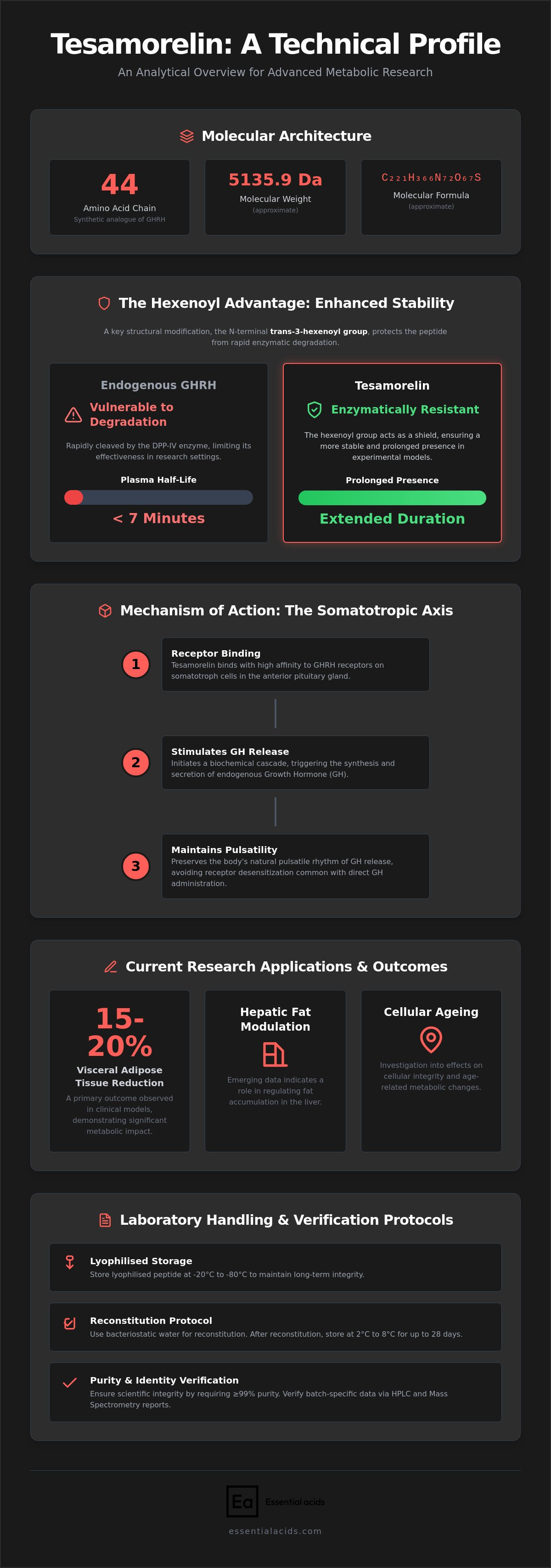
Tesamorelin is defined as a synthetic analogue of endogenous growth hormone-releasing hormone (GHRH). It's composed of a specific sequence of 44 amino acids. The approximate molecular formula for this peptide is C221H366N72O67S, and it possesses a molecular weight of approximately 5135.9 Da. Within the context of laboratory investigation, the compound is classified as a secretagogue. It's designed to interact with the somatotropic axis by stimulating the production and release of growth hormone from the anterior pituitary gland. This mechanism is central to ongoing tesamorelin research focused on metabolic regulation and cellular integrity.
The most significant structural feature of this molecule is the addition of a trans-3-hexenoyl group at the N-terminal position. This specific modification distinguishes it from the native GHRH peptide produced in the human hypothalamus. The hexenoyl group provides a chemical shield that enhances enzymatic resistance. Specifically, it protects the peptide from rapid cleavage by dipeptidyl peptidase IV (DPP-IV). This enzyme is the primary catalyst for the degradation of endogenous GHRH. By blocking this pathway, the molecular architecture of the compound ensures a more stable and prolonged presence in experimental models, allowing for more precise measurement of somatotropic signaling.
Comparison to Endogenous GHRH (1-44)
Endogenous human GHRH (1-44) is the natural ligand for the pituitary GHRH receptor. However, its utility in a laboratory setting is often limited by a plasma half-life of less than seven minutes. The hexenoyl-stabilized analogue addresses this limitation by extending the duration of receptor occupancy without sacrificing affinity. While shorter fragments like GHRH (1-29) are sometimes used in preliminary studies, the full 44-amino acid structure of Tesamorelin is generally preferred for metabolic research. The complete chain provides superior conformational stability, which is necessary for investigating complex feedback loops within the IGF-1 axis.
Synthetic Evolution and Purity Standards in 2026
The transition from early GHRH research to current high-stability analogues reflects a move toward greater analytical discipline. In 2026, the standard for analytical-grade reagents has shifted to a requirement for ≥99% purity. Maintaining this level of integrity is vital for ensuring that experimental outcomes aren't skewed by truncated sequences or synthesis byproducts. Researchers seeking to establish high-integrity protocols should refer to the technical guide to laboratory procurement. Verifying batch-specific data through HPLC and Mass Spectrometry remains the only reliable method for confirming that a compound meets these rigorous scientific benchmarks.
Mechanisms of Action: The Somatotropic Axis and GHRH Receptor Binding
The primary mechanism driving tesamorelin research involves the compound's high affinity for the Growth Hormone-Releasing Hormone Receptor (GHRHR). This G protein-coupled receptor is situated on the surface of somatotroph cells within the anterior pituitary. Upon binding, the peptide initiates a biochemical cascade that triggers the synthesis and secretion of endogenous growth hormone (GH). Unlike the direct administration of exogenous growth hormone, which often leads to sustained, supra-physiological elevations, this analogue maintains the body's natural pulsatile rhythm of GH release. This preservation of pulsatility is a critical variable in metabolic research, as it avoids the common desensitisation of peripheral receptors associated with continuous GH exposure.
This regulated secretion is further governed by a complex interplay with somatostatin, the primary inhibitory peptide of the somatotropic axis. In experimental models, the efficacy of the secretagogue is often measured by its ability to overcome somatostatin-mediated suppression without disrupting the underlying regulatory feedback loops. Maintaining this balance ensures that the resulting metabolic changes remain within a range that mimics physiological norms. Researchers interested in these precise interactions can find Tesamorelin Clinical and Research Information to further validate their experimental designs.
Pituitary GH Secretion and Signal Transduction
The intracellular response begins with the activation of the adenylate cyclase pathway, leading to a significant increase in intracellular cyclic adenosine monophosphate (cAMP). This rise in cAMP activates protein kinase A, which subsequently opens calcium channels. The resulting influx of calcium ions triggers the calcium-dependent exocytosis of GH-containing vesicles into the systemic circulation. When compared to other secretagogues like Ipamorelin, this compound demonstrates a distinct signaling profile. While ghrelin mimetics act via the growth hormone secretagogue receptor (GHS-R), this analogue works directly through the GHRH pathway, providing a more targeted approach for somatotropic modulation.
IGF-1 Modulation and Feedback Loops
Following the pituitary release of GH, the liver initiates the synthesis of Insulin-like Growth Factor 1 (IGF-1). This polypeptide serves as the primary mediator for many of the metabolic and anabolic effects observed in research settings. IGF-1 levels are typically monitored as the definitive biomarker for the activity of the somatotropic axis. Elevated IGF-1 promotes protein synthesis and cellular metabolism while concurrently exerting negative feedback on the pituitary and hypothalamus. This feedback mechanism ensures that GH production remains regulated. For laboratories requiring consistent results, sourcing verified analytical-grade compounds is vital to ensure that the observed IGF-1 responses are the result of high-purity reagents rather than synthesis contaminants.
Current Research Directions: Adipose Tissue and Hepatic Fat Models
While early investigations focused primarily on HIV-associated lipodystrophy, current tesamorelin research has expanded into broader metabolic syndrome models. The compound's ability to selectively target visceral adipose tissue (VAT) without significantly impacting subcutaneous fat makes it a unique tool for studying regional adiposity. Researchers are increasingly utilizing this GHRH analogue to investigate the systemic implications of VAT reduction, particularly regarding insulin sensitivity and cardiovascular risk markers. By modulating the somatotropic axis, the peptide influences the secretion of inflammatory cytokines, such as C-reactive protein (CRP), providing a framework for studying the link between deep-tissue fat and systemic inflammation.
The disciplined application of this compound in laboratory settings allows for the isolation of GH-mediated lipolysis from other metabolic variables. This is essential for establishing clear cause-and-effect relationships in complex metabolic environments. As the scientific community moves toward 2026 standards, the focus remains on the precision of these interactions and the long-term stability of the results within preclinical models. Sourcing high-purity reagents is the only way to ensure that these observations are not confounded by synthesis impurities or degraded peptide chains.
Visceral Adiposity and Lipolysis Mechanisms
Growth hormone induces lipolysis by increasing the expression of hormone-sensitive lipase and inhibiting lipoprotein lipase. In visceral fat depots, these mechanisms appear more sensitive to somatotropic signaling than in subcutaneous areas. Studies have demonstrated a VAT reduction of approximately 15% to 20% over 26-week periods in specific models. There is growing interest in synergistic research designs that combine GHRH analogues with GLP-1 or GIP receptor agonists. For instance, analyzing the concurrent use of Tirzepatide alongside Tesamorelin may provide deeper insights into dual-pathway modulation of body composition and glucose metabolism.
Hepatic Fat and Liver Health Research
A significant gap in existing literature involves the role of GHRH analogues in non-alcoholic fatty liver disease (NAFLD) research. Recent data indicates that this compound can reduce liver fat by an average of 37% in specific cohorts, highlighting its potential for investigation in NASH and hepatic steatosis models. This reduction in intrahepatic triglycerides suggests a direct or IGF-1 mediated effect on hepatic lipid oxidation. These findings are often integrated into systemic inflammation models, where researchers also examine the secondary effects on peripheral tissues. This includes exploring the relationship between metabolic health and dermal integrity, often cross-referencing data with peptides for skin research to assess the impact of growth hormone on cellular ageing and tissue repair.
Laboratory Standards: Handling, Reconstitution, and Analytical Verification
The precision of tesamorelin research depends heavily on the preservation of the peptide's structural integrity. As a 44-amino acid chain with a specific hexenoyl modification, this compound is highly susceptible to molecular degradation if handling standards are compromised. Lyophilised powder must be stored in a controlled environment to prevent premature hydrolysis or oxidation. For short-term laboratory use, storage at -20°C is sufficient. However, for long-term stability exceeding six months, the peptide should be maintained at -80°C. Exposure to light and ambient temperature should be minimised during the weighing and aliquotting phases to ensure the compound's chemical signature remains unaltered.
Denaturation is a primary concern during the transition from a lyophilised state to a liquid solution. Mechanical stress, such as vigorous shaking, can disrupt the secondary structure of the peptide, rendering it inactive for somatotropic assays. Reconstituted solutions are significantly more fragile than their freeze-dried counterparts. If the research design requires multiple withdrawals from a single vial over several weeks, the use of bacteriostatic water containing 0.9% benzyl alcohol is the established standard. This diluent inhibits microbial growth and allows the solution to remain stable for up to 28 days when refrigerated between 2°C and 8°C.
Reconstitution and Concentration Calculations
To reconstitute the peptide, the diluent should be introduced slowly, allowing it to flow down the interior wall of the glass vial. This technique prevents the formation of bubbles and reduces the risk of peptide shearing. Once the liquid is added, the vial should be gently swirled until the solution is clear and free of particulates. Calculating molar concentrations for in vitro models requires precise measurements based on the approximate molecular weight of 5135.9 Da. For accurate dosing in metabolic models, researchers must account for the displacement volume of the powder to ensure the final concentration is exact.
Verifying Chemical Integrity
Analytical verification is the final safeguard in maintaining scientific integrity. High-Performance Liquid Chromatography (HPLC) is employed to identify the specific peak corresponding to Tesamorelin (CAS 218949-48-5), ensuring that no truncated sequences or synthesis byproducts are present. Mass Spectrometry (MS) is further utilized to confirm that the molecular mass aligns with the theoretical profile. These reports should be batch-specific, as generic documentation fails to account for variations in synthesis runs. Sourcing analytical-grade Tesamorelin with verified HPLC and MS data is essential for ensuring that research outcomes are both reproducible and credible.
Procuring Research-Grade Tesamorelin: Scientific Integrity in 2026
The acquisition of analytical-grade compounds for tesamorelin research requires a strict adherence to procurement standards that prioritize chemical identity over commercial availability. In 2026, the Australian regulatory landscape for research-only chemicals remains stringent, requiring clear distinctions between therapeutic goods and laboratory reagents. Essential Acids operates within this framework by providing high-purity peptides intended strictly for in vitro and in vivo experimental models. This commitment to transparency ensures that researchers can account for every variable in their somatotropic signaling studies without the interference of unknown contaminants.
Accessing batch-specific documentation isn't an elective part of the scientific process; it's a fundamental requirement for data validity. Providing comprehensive purity reports, including High-Performance Liquid Chromatography (HPLC) and Mass Spectrometry (MS) data, allows for the verification of the 44-amino acid sequence and the hexenoyl modification. This level of detail is essential for the reproducibility of metabolic studies, where even minor variations in peptide purity can lead to significant discrepancies in IGF-1 response data. By maintaining a professional distance from the consumer marketplace, we ensure that the focus remains on the gravity of laboratory investigation.
The Essential Acids Quality Framework
Our framework is built on the principle of scientific integrity, ensuring that every vial of lyophilised powder meets analytical benchmarks. We maintain a rigorous testing schedule that evaluates the stability and identity of each batch before it enters the research supply chain. The "Research Use Only" designation isn't merely a legal disclaimer; it's a professional boundary that defines the scope of our operations. By focusing exclusively on the needs of the scientific community, we provide the technical support necessary for selecting the correct molecular profiles for specific metabolic models. This disciplined approach ensures that the compounds provided are fit for high-level biochemical investigation.
Advancing Metabolic Science
The trajectory of tesamorelin research suggests an increasing focus on the intersection of the somatotropic axis and cellular ageing. As laboratory models become more sophisticated, the demand for high-stability GHRH analogues will continue to grow. Collaborating with a high-integrity supplier is the most effective way to ensure that long-term data remains valid and untainted by reagent degradation. At Essential Acids, our philosophy of "Making better, normal" is reflected in our dedication to providing the tools required for these visionary discoveries. Researchers must prioritize analytical documentation and batch-specific verification to ensure their findings contribute meaningfully to the advancement of metabolic science. Sourcing verified research peptides remains the standard for those who value precision and technical transparency.
Advancing Scientific Integrity in Somatotropic Axis Research
The technical profile of this 44-amino acid analogue highlights the critical role of the hexenoyl modification in resisting enzymatic degradation. By maintaining a pulsatile growth hormone release, it offers a refined model for investigating visceral adiposity and hepatic fat modulation. The validity of tesamorelin research depends on the rigorous application of analytical standards, including precise reconstitution and cold-chain storage. Researchers must prioritize chemical identity through verified documentation to ensure data validity in 2026. This disciplined approach is necessary for reproducing complex metabolic outcomes across laboratory environments.
Essential Acids serves as a dedicated national Australian research supply partner, providing the high-purity reagents required for advanced biochemical investigation. Every compound is verified through batch-specific HPLC reports to maintain an unwavering focus on scientific integrity. This commitment to quality supports the "Making better, normal" philosophy by ensuring that laboratory data remains accurate and untainted by synthesis impurities. We invite researchers to Procure High-Purity Tesamorelin for Laboratory Research and establish a foundation of technical transparency for their next study. Your pursuit of precise metabolic insights drives the future of cellular science.
Frequently Asked Questions
What is the molecular weight and chemical formula of Tesamorelin?
Tesamorelin possesses an approximate chemical formula of C221H366N72O67S and a molecular weight of approximately 5135.9 Da. These values are critical for calculating molar concentrations during in vitro assays. Maintaining these precise specifications ensures that the compound behaves predictably within established metabolic models, allowing for accurate quantification of receptor binding and signal transduction.
How does the hexenoyl modification improve Tesamorelin stability?
The addition of a trans-3-hexenoyl group to the N-terminal of the 44-amino acid chain provides superior resistance to enzymatic cleavage. Specifically, it blocks the action of dipeptidyl peptidase IV (DPP-IV), which is the primary enzyme responsible for degrading endogenous GHRH. This modification allows for a more stable presence in tesamorelin research environments, facilitating longer observation windows for somatotropic signaling compared to native GHRH.
What is the recommended reconstitution volume for a Tesamorelin research vial?
Reconstitution typically requires 0.5 mL to 1.0 mL of diluent per 2 mg of lyophilised powder, depending on the required molarity of the research protocol. Bacteriostatic water is the preferred diluent for multidose research applications due to its antimicrobial properties. The diluent must be introduced slowly down the side of the vial to avoid disrupting the peptide bonds through mechanical shear stress.
Can Tesamorelin be used for clinical diagnosis or human consumption?
No, these compounds are strictly for laboratory investigation and are not intended for human consumption or clinical diagnostic use. Essential Acids prioritizes scientific integrity by ensuring all products are labeled and handled as research-use only chemicals. Any use outside of a controlled laboratory setting is a violation of established safety protocols and Australian regulatory standards for analytical reagents.
How long is Tesamorelin stable after reconstitution in a laboratory setting?
Reconstituted solutions remain stable for up to 28 days when stored under refrigeration between 2°C and 8°C. This stability timeline assumes the use of bacteriostatic water containing 0.9% benzyl alcohol as the diluent. If sterile saline is used, the solution should be utilized immediately and discarded, as it lacks the preservative qualities necessary for prolonged storage and is more susceptible to rapid degradation.
What are the primary metabolic pathways targeted by Tesamorelin research?
Tesamorelin research primarily targets the somatotropic axis by stimulating the GHRH receptors in the anterior pituitary. This interaction triggers the pulsatile release of endogenous growth hormone, which subsequently modulates hepatic IGF-1 synthesis. These pathways are essential for studying lipolysis in visceral adipose tissue and investigating intrahepatic triglyceride reduction in metabolic models without disrupting natural feedback loops.
How does Tesamorelin compare to Ipamorelin in research models?
Tesamorelin is a direct GHRH receptor agonist, whereas Ipamorelin acts as a ghrelin mimetic by targeting the growth hormone secretagogue receptor (GHS-R). While both compounds stimulate GH release, their signaling pathways are distinct. Researchers often select the GHRH analogue when the study requires a mechanism that more closely mimics the natural hypothalamic-pituitary interaction and maintains the body's pulsatile GH rhythm.
What analytical methods are used to verify the purity of Tesamorelin?
Scientific integrity is verified through batch-specific High-Performance Liquid Chromatography (HPLC) and Mass Spectrometry (MS). HPLC identifies the specific peak of the 44-amino acid sequence to confirm purity levels, while MS verifies that the molecular mass of the compound aligns with the theoretical profile. These analytical reports are essential for ensuring that research data is reproducible and free from synthesis contaminants or truncated sequences.
Legal Disclaimer
All products sold on this website are intended exclusively for laboratory research purposes and not for human or veterinary use, diagnosis, cure, treatment, or prevention of any disease or condition. None of the statements on this site have been reviewed or evaluated by the U.S. Food and Drug Administration (FDA) or comparable regulatory authorities. Purchasing or using these products for any unintended purpose, including human consumption, may violate federal or local laws and poses safety risks.