

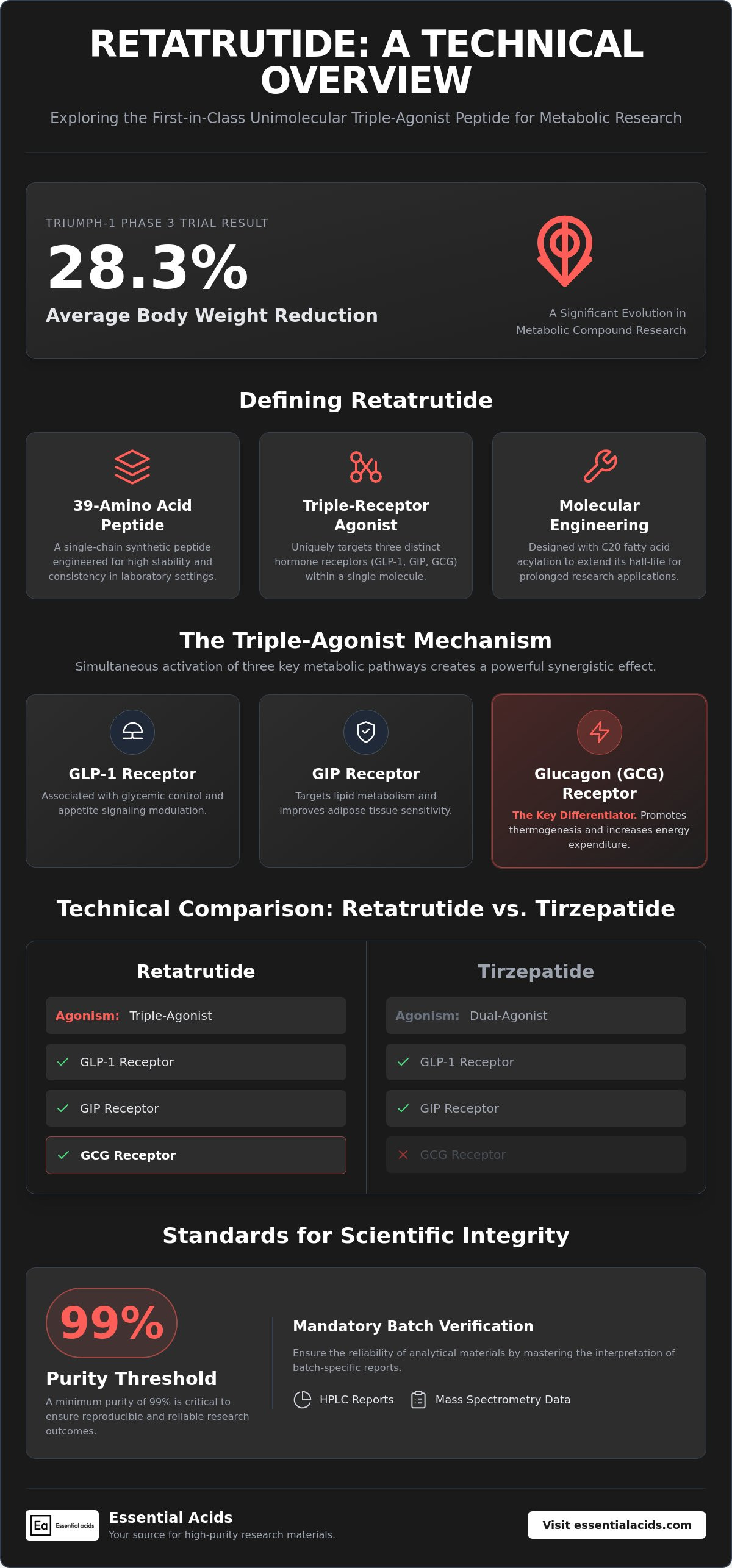
The achievement of a 28.3% average body weight reduction in the TRIUMPH-1 Phase 3 trial marks a significant evolution in metabolic research, moving beyond the capabilities of dual-agonist predecessors. While clinical specialists at the Houston Medical Wellness Clinic track these results for their potential impact on future wellness protocols, researchers face the challenge of navigating the technical data required for precise laboratory application. You're likely seeking a deeper understanding of the specific molecular engineering that allows a single peptide to target three distinct hormone receptors. This article defines what is retatrutide by examining its biochemical structure and the specific role of the glucagon receptor in increasing energy expenditure.
We'll explore the triple-agonist mechanism of LY-3437943, including the fatty acid acylation that extends its half-life for research purposes. You'll gain a clear differentiation between this first-in-class peptide and existing dual-agonists like tirzepatide. Finally, the discussion outlines the essential procurement standards for high-purity materials, emphasizing the importance of batch-verified analytical reports to maintain scientific integrity in Australian laboratory settings.
Key Takeaways
- Understand the synergetic interaction between GLP-1, GIP, and glucagon receptors that differentiates triple-agonists from earlier dual-agonist models.
- Examine the molecular engineering behind C20 fatty acid diacid acylation and how it facilitates albumin binding to prevent rapid proteolytic degradation.
- Identify the technical structural differences between tirzepatide and retatrutide to better anticipate receptor-specific research outcomes.
- Learn what is retatrutide in a laboratory context and why maintaining a 99% purity threshold is critical for scientific integrity.
- Master the interpretation of batch-specific HPLC and Mass Spectrometry reports to ensure the reliability of analytical research materials.
Defining Retatrutide: Molecular Classification and Amino Acid Structure
Retatrutide is a synthetic, single-chain peptide comprising 39 amino acids. It represents a significant departure from traditional metabolic compounds. Unlike single-receptor agonists, this molecule acts as a unimolecular triple-agonist. It targets the glucagon-like peptide-1 (GLP-1), glucose-dependent insulinotropic polypeptide (GIP), and glucagon (GCG) receptors simultaneously. Researchers investigating what is retatrutide often focus on its capacity to modulate these three distinct pathways within a single chemical structure. This multi-receptor approach is essential for studying complex metabolic interactions that endogenous hormones cannot replicate in isolation. The peptide's design allows for a broader investigative scope into metabolic flux and cellular energy expenditure within controlled laboratory settings.
Peptide vs. Protein: The 39-Amino Acid Chain
The classification of Retatrutide as a peptide is determined by its specific sequence of 39 amino acids. Proteins typically consist of longer, more complex chains; this specific length allows for precise structural control during the manufacturing process. Production occurs via Solid-Phase Peptide Synthesis (SPPS). This method ensures high molecular consistency and batch-to-batch integrity, which is vital for reproducible research. The resulting peptide backbone is engineered for stability in laboratory environments. It maintains its structural integrity during cellular signaling assays and standard storage protocols. It's built to withstand standard laboratory handling without the immediate degradation common in less stable protein structures.
Synthetic Engineering for Metabolic Research
Retatrutide isn't a naturally occurring substance. It's a product of precise molecular engineering designed to mimic and enhance the activity of natural incretins. By integrating triple-agonism into one molecule, it provides a unique tool for studying metabolic pathways like lipid oxidation and glucose homeostasis. The primary objective of this engineering is to observe how simultaneous receptor activation impacts cellular models differently than dual-agonist alternatives. It's crucial to differentiate research-grade Retatrutide from clinical pharmaceutical products. While the molecular sequence might be identical, research-grade materials are intended strictly for laboratory applications. They aren't human-grade pharmaceuticals and don't carry the necessary clinical certifications for non-research use. In the Australian research sector, the focus remains on high-purity compounds that allow for the objective analysis of multi-receptor signaling without the variables introduced by lower-grade materials. Scientific integrity is maintained by adhering to these strict classification boundaries.
The Triple-Agonist Mechanism: GLP-1, GIP, and Glucagon Synergism
Understanding the mechanism behind what is retatrutide requires an analysis of its interaction with three distinct incretin and metabolic receptors. The peptide functions as an agonist at the Glucagon-Like Peptide-1 (GLP-1), Glucose-Dependent Insulinotropic Polypeptide (GIP), and Glucagon (GCG) receptors. While GLP-1 receptor activation is traditionally associated with appetite signaling and glycemic control, the inclusion of GIP agonism targets lipid metabolism and adipose tissue sensitivity. This dual action is common in contemporary research, but Retatrutide introduces a third component. The simultaneous activation of these pathways creates a synergistic effect that exceeds the capabilities of single-receptor agonists. This synergy is central to investigating how multi-pathway signaling alters metabolic benchmarks in laboratory environments.
The Glucagon Receptor: The Third Pillar of Retatrutide
The GCG receptor component is what distinguishes this molecule's profile from the tirzepatide structure, which only targets GLP-1 and GIP. Glucagon plays a critical biochemical role in stimulating hepatic glucose production and promoting thermogenesis. By incorporating GCG agonism, the peptide enables researchers to investigate energy expenditure and mitochondrial function more comprehensively. This addition is achieved through specific amino acid substitutions in the peptide sequence. For example, the inclusion of specific residues at positions 2 and 20 allows for high-affinity binding to the glucagon receptor without compromising the potency at the other two sites. It provides a unique model for studying the reversal of metabolic dysfunction through increased metabolic rate. This third pillar allows for a more holistic view of cellular energy management than dual-agonist models provide.
Receptor Binding Affinity in Cellular Models
Potency and binding affinity are calibrated to ensure balanced metabolic signaling across all three targets. Retatrutide exhibits high potency at the human GIP, GLP-1, and GCG receptors, with half-maximal effective concentrations (EC50) typically in the low picomolar range. Retatrutide demonstrates potent agonistic activity at the GIP receptor, which serves as a primary driver for its metabolic effects in cellular models. This balanced affinity prevents one receptor pathway from overwhelming the others, allowing for a stabilized investigative environment. Researchers requiring high-integrity compounds for these complex assays can find verified Retatrutide for laboratory applications. The precise ratio of receptor activation is a key variable in determining the overall metabolic shift observed during long-term research studies. Maintaining this balance is essential for the integrity of data involving multi-receptor cross-talk.
Molecular Engineering: Fatty Acid Acylation and Stability
The structural longevity of the molecule is a result of precise acylation, a process that determines how the peptide behaves in a biological matrix. Defining what is retatrutide requires looking beyond its amino acid sequence to the C20 fatty acid diacid moiety attached to the lysine residue at position 17. This specific engineering choice isn't merely for structural complexity; it's the primary mechanism for extending the peptide's half-life. By facilitating reversible binding to serum albumin, the acylation protects the molecule from rapid renal clearance. This binding creates a circulating reservoir of the peptide, allowing for sustained receptor activation over an extended period. For researchers, this means the compound remains active in cellular models significantly longer than non-acylated peptides.
Fatty Acid Acylation and Albumin Binding
The C20 fatty acid diacid side chain enables the peptide to anchor itself to albumin, a common carrier protein in research models. This interaction is reversible, ensuring that a fraction of the peptide is always available for receptor binding while the remainder is shielded from proteolytic degradation. This molecular design is a benchmark in high-integrity research. It aligns with the rigorous retatrutide for sale standards required for metabolic studies in Australia. Without this acylation, the peptide would likely face rapid degradation, making long-term metabolic observations impossible. The stability provided by this side chain allows for more consistent data collection across multi-day laboratory protocols.
Sequence Modifications for Resistance to DPP-4
Beyond acylation, specific amino acid substitutions are engineered into the backbone to resist enzymatic breakdown. Modifications at position 2, typically involving alpha-aminoisobutyric acid, and at position 13, are designed to protect the peptide from dipeptidyl peptidase-4 (DPP-4). This enzyme is responsible for the rapid inactivation of endogenous incretins. By altering these specific sites, the structural integrity of the peptide is maintained even during long-term in-vitro experiments. The molecular weight of Retatrutide is approximately 4731 Da. These modifications ensure that the triple-agonist mechanism described in previous sections remains functional throughout the duration of the study. Researchers must account for this stability when calculating reconstitution volumes and administration intervals. Because the peptide resists standard degradation pathways, it provides a highly reliable model for investigating chronic metabolic signaling without the need for constant re-administration.
Retatrutide vs. Tirzepatide: A Technical Comparison for Researchers
The evolution from dual to triple agonism represents a refined approach to investigating metabolic pathways in laboratory settings. While tirzepatide focuses on GLP-1 and GIP signaling, understanding what is retatrutide involves acknowledging the strategic integration of the glucagon receptor. This structural evolution allows for a broader investigative scope that earlier dual-agonist models couldn't achieve. Tirzepatide's primary mechanism centers on insulin sensitivity and appetite suppression, providing a robust model for glycemic research. Retatrutide, however, shifts the focus toward increasing energy expenditure through glucagon signaling. This difference is critical for researchers designing protocols for complex metabolic disorders where thermogenesis is a primary variable.
From Dual to Triple Agonism: Structural Evolution
The biochemical rationale for adding the glucagon component lies in its ability to modulate hepatic glucose production and activate thermogenic pathways. In research models, receptor 'bias'-the degree to which a peptide activates one receptor over another-determines the experimental outcome. Tirzepatide acts primarily as a GIP-preferential dual agonist, which is highly effective for studying adipose tissue sensitivity. In contrast, Retatrutide is engineered for balanced activity across all three targets. Choosing between these molecules depends on whether the research objective focuses on glycemic control or the activation of energy expenditure. Some researchers explore how 5-amino-1mq might interact with these pathways by inhibiting NNMT, potentially providing a multi-layered approach to metabolic flux studies. The decision to use a triple-agonist often hinges on the need to observe simultaneous increases in metabolic rate and insulin sensitivity within a single model.
Potency and Efficacy in In-Vitro Metabolic Studies
Comparative data suggests that triple-agonists provide a more robust model for studying lipid oxidation than dual-agonists. In cellular assays, the addition of glucagon agonism appears to enhance mitochondrial biogenesis, a factor that is less pronounced in GLP-1/GIP models. This makes it an ideal candidate for research involving mitochondrial-derived peptides like mots c peptide. Investigating the cross-talk between triple-agonists and mitochondrial signaling helps clarify the role of the GCG receptor in cellular energy management. Analytical considerations for multi-agonist peptide reconstitution are more complex; researchers must ensure that the peptide remains stable in solution to maintain the integrity of the balanced receptor profile. For those conducting detailed metabolic assays, you can buy Retatrutide for laboratory use to investigate these advanced triple-agonist mechanisms. The precision of the 39-amino-acid chain ensures that the triple-agonist effect is reproducible across different batches, provided that high-purity standards are maintained throughout the procurement process.
Procurement and Purity Standards for Laboratory Research
The integrity of metabolic data is directly proportional to the chemical purity of the compounds utilized in the laboratory. When defining what is retatrutide for analytical purposes, the definition must include a purity threshold of at least 99%. Synthetic peptides are susceptible to the presence of truncated sequences or residual solvents from the Solid-Phase Peptide Synthesis process. These impurities can introduce significant variables into cellular assays, potentially confounding results in multi-receptor signaling studies. Scientific integrity requires that each batch be accompanied by verifiable analytical documentation. Without this level of transparency, the reliability of the research is compromised. Maintaining these high standards ensures that the observed metabolic shifts are a result of the peptide's triple-agonist mechanism rather than unintended chemical interference.
Verifying Purity: HPLC and MS Analysis
Batch-specific analytical reports are non-negotiable for researchers requiring precise molecular profiles. High-Performance Liquid Chromatography (HPLC) is utilized to determine the chemical purity of the peptide by measuring the peak area of the target molecule relative to impurities. Mass Spectrometry (MS) is then employed to confirm the molecular weight, ensuring that the 39-amino-acid chain matches the theoretical mass of approximately 4731 Da. A Certificate of Analysis (COA) provides a comprehensive overview of these findings. It allows researchers to identify any deviations in the peptide's mass or purity before the commencement of an experiment. Identifying truncated sequences is vital. Even minor structural errors can alter the balanced receptor binding affinity that defines this molecule. Researchers must scrutinize these reports to ensure the compound's integrity hasn't been compromised during manufacturing or transport.
The Essential Acids 'Research Use Only' Protocol
Essential Acids operates with a strict adherence to laboratory and analytical research applications. Every compound, including Retatrutide, is provided under a "research-use only" policy. This protocol ensures compliance with national Australian standards for laboratory materials, maintaining a clear boundary between research reagents and clinical pharmaceuticals. Lyophilised Retatrutide must be stored at -20°C for short-term stability or -80°C for long-term preservation to prevent proteolytic degradation. This disciplined approach to storage and distribution supports the brand's commitment to "Making better, normal" through the provision of high-integrity compounds. By prioritizing transparency and batch-specific verification, the brand serves as a reliable partner for the Australian scientific community. All procedures are designed to convey information with maximum clarity, ensuring that the quality of the compounds remains the primary focus. This consistency is essential for researchers who depend on stable, well-regulated supply chains to advance metabolic science within the strictly objective framework of the laboratory.
Advancing Metabolic Research with Triple-Agonist Precision
Retatrutide represents a significant structural advancement by integrating glucagon receptor activation with established incretin pathways. This triple-agonist profile allows for the investigation of energy expenditure and thermogenesis alongside traditional glycemic signaling. Understanding what is retatrutide requires a commitment to examining the specific molecular engineering, such as the C20 fatty acid acylation, that ensures stability in analytical environments. This level of complexity provides a more comprehensive model for metabolic research than previous dual-agonist iterations.
Scientific integrity is maintained through the use of high-purity compounds that meet rigorous laboratory standards. For researchers in Australia, the availability of batch-specific HPLC and MS reports is essential for verifying the identity and purity of each compound. These materials are provided strictly for laboratory and analytical use, ensuring that data remains objective and reproducible across all experiments. Maintaining these standards is critical for the progression of metabolic science.
View Analytical Documentation for Research Peptides to ensure your laboratory protocols are supported by verified high-purity standards and batch-specific integrity reports. We look forward to supporting your contribution to the evolving landscape of metabolic research.
Frequently Asked Questions
Is Retatrutide a peptide or a small molecule drug?
Retatrutide is a synthetic peptide rather than a small molecule drug. It consists of a 39-amino-acid chain engineered specifically for research applications. Unlike small molecule drugs that are typically produced through chemical synthesis of non-peptide compounds, this molecule is manufactured via solid-phase peptide synthesis. This distinction is critical for researchers defining what is retatrutide when selecting compounds for metabolic signaling assays.
What is the molecular weight of Retatrutide?
The molecular weight of Retatrutide is approximately 4731 Da. This value corresponds to its 39-amino-acid sequence and the specific fatty acid side chain used for stability. Confirmation of this mass is a standard part of batch-specific analytical reports. Researchers use this data to ensure the compound matches the theoretical profile before starting experiments. It's an essential metric for calculating molar concentrations in laboratory assays.
How does Retatrutide differ from Tirzepatide in research?
The primary difference between Retatrutide and tirzepatide is the receptor target profile. Tirzepatide is a dual-agonist targeting GLP-1 and GIP receptors, while Retatrutide is a first-in-class triple-agonist that also activates the glucagon (GCG) receptor. This additional signaling pathway enables researchers to investigate thermogenesis and hepatic energy expenditure. It's a more complex tool for studying multi-receptor metabolic flux than dual-agonist alternatives.
Is Retatrutide intended for human or veterinary use?
Retatrutide is strictly for laboratory and analytical research use only and is not intended for human or veterinary consumption. All compounds provided are designated for in-vitro or in-vivo laboratory studies. Compliance with Australian research regulations is mandatory. Essential Acids maintains a firm policy regarding the research-use only status of its products to ensure scientific integrity and regulatory transparency across all laboratory applications.
What are the storage requirements for lyophilised Retatrutide?
Lyophilised Retatrutide requires storage at -20°C for short-term maintenance of its structural integrity. For long-term preservation of scientific integrity, storage at -80°C is recommended to prevent degradation. The peptide should be kept in a desiccated environment and protected from light. Following reconstitution, the solution should be used promptly or stored at 4°C for no more than 24 to 48 hours to avoid potential proteolytic breakdown.
Does Retatrutide require bacteriostatic water for reconstitution in a lab?
Bacteriostatic water is the standard solvent for the reconstitution of Retatrutide in a laboratory setting. This solvent contains 0.9% benzyl alcohol, which serves as a preservative to inhibit bacterial growth. Using this solvent is critical for maintaining the stability of the peptide during multi-day research protocols. Sterile water may be used for immediate single-use assays, but bacteriostatic water is preferred for experiments requiring repeated sampling from the same vial.
What is the half-life of Retatrutide in laboratory research models?
The half-life of Retatrutide is approximately 6 days in laboratory research models. This prolonged activity is achieved through C20 fatty acid diacid acylation, which facilitates reversible binding to serum albumin. This mechanism prevents rapid proteolytic degradation and slows renal clearance. Understanding what is retatrutide in terms of its pharmacokinetic stability allows researchers to plan administration intervals more accurately during long-term metabolic studies.
Why is glucagon receptor agonism significant in metabolic research?
Glucagon receptor agonism is significant because it introduces the capacity to study increased energy expenditure and hepatic glucose production. While GLP-1 and GIP primarily influence insulin sensitivity and appetite, the glucagon component targets mitochondrial thermogenesis. This allows for a more holistic investigation of metabolic homeostasis in cellular models. It provides a unique investigative tool for observing how simultaneous receptor activation affects lipid oxidation and energy balance.
Legal Disclaimer
All products sold on this website are intended exclusively for laboratory research purposes and not for human or veterinary use, diagnosis, cure, treatment, or prevention of any disease or condition. None of the statements on this site have been reviewed or evaluated by the U.S. Food and Drug Administration (FDA) or comparable regulatory authorities. Purchasing or using these products for any unintended purpose, including human consumption, may violate federal or local laws and poses safety risks.