

The assumption that research grade peptides are merely a lower-tier version of pharmaceutical products is a technical fallacy that risks the validity of your data. In a landscape where the FDA reclassified 14 peptides for compounding as of April 23, 2026, the distinction between clinical and analytical standards is vital for regulatory compliance. You probably find the current procurement environment exhausting; it's a space filled with complex HPLC reports and ambiguous labels that make it difficult to trust a supplier.
We recognize that batch-to-batch inconsistency is a significant threat to disciplined laboratory work. This article provides the technical framework to distinguish between purity and potency while ensuring your applications maintain scientific integrity. You'll learn to verify peptide quality independently and interpret modern analytical data to select high-integrity materials with absolute confidence. Making better, normal requires an objective commitment to the precision of the compounds used in your research.
Key Takeaways
- Distinguish between analytical standards and clinical classifications to understand why research grade peptides are optimized for laboratory precision.
- Deconstruct the myth that pharmaceutical labels inherently guarantee higher chemical purity for non-clinical biochemical applications.
- Identify the critical differences between purity percentages and actual peptide potency to prevent batch-to-batch inconsistency in your data.
- Master the interpretation of independent HPLC and Mass Spectrometry reports to verify molecular identity and scientific integrity.
- Implement a disciplined procurement protocol that prioritizes regulatory compliance and transparent quality assurance.
Defining Research Grade Peptides: The Foundation of Scientific Inquiry
Research grade peptides are chemical compounds synthesized specifically for use in controlled laboratory environments. These molecules are designed to facilitate in vitro studies and analytical research where the primary objective is the observation of biological mechanisms. Unlike pharmaceutical grade products, which are manufactured for clinical administration, the production of research grade materials focuses on sequence accuracy and chemical consistency for experimental reproducibility. This distinction is fundamental to maintaining scientific integrity in any metabolic or cellular study. A researcher’s data is only as reliable as the compounds used; therefore, the quality of these peptides is measured by their adherence to theoretical specifications rather than their suitability for human use.
The Role of Peptides in Modern Biochemistry
In contemporary biochemistry, a peptide serves as a critical signaling molecule. These short chains of amino acids allow scientists to probe complex cellular responses and metabolic health pathways with high specificity. The process of Peptide synthesis must be executed with precision to ensure the resulting molecule matches its intended biological target. Even a minor deviation in the amino acid sequence can lead to significant errors in molecular weight and sequence accuracy, rendering analytical studies invalid. Researchers utilize a diverse catalog of research grade peptides, such as 5-Amino-1MQ for enzymatic studies or BPC-157 for investigating tissue signaling, to advance our understanding of biological potential. Each compound must be verified through rigorous analytical methods to confirm it meets the required research standards.
Why 'Research Use Only' is a Safety Standard
The "research use only" (RUO) label represents a critical regulatory and safety boundary. It establishes a clear legal distinction between laboratory chemicals and therapeutic agents approved for medical use. Most research compounds haven't undergone the multi-phase human clinical trials necessary to establish safety profiles for consumption. In professional laboratory settings, this designation is a non-negotiable standard that protects both the researcher and the integrity of the institution. The prohibition of human or veterinary consumption is absolute. This disciplined approach ensures that the focus remains strictly on objective data collection and the exploration of biological processes. By adhering to these protocols, suppliers and researchers maintain a professional distance from the unregulated "gray market," prioritizing transparency and regulatory compliance over commercial trends. It's this commitment to rules and precision that defines the high-integrity procurement process.
Myth: 'Pharma Grade' is the Only Standard for High-Quality Research
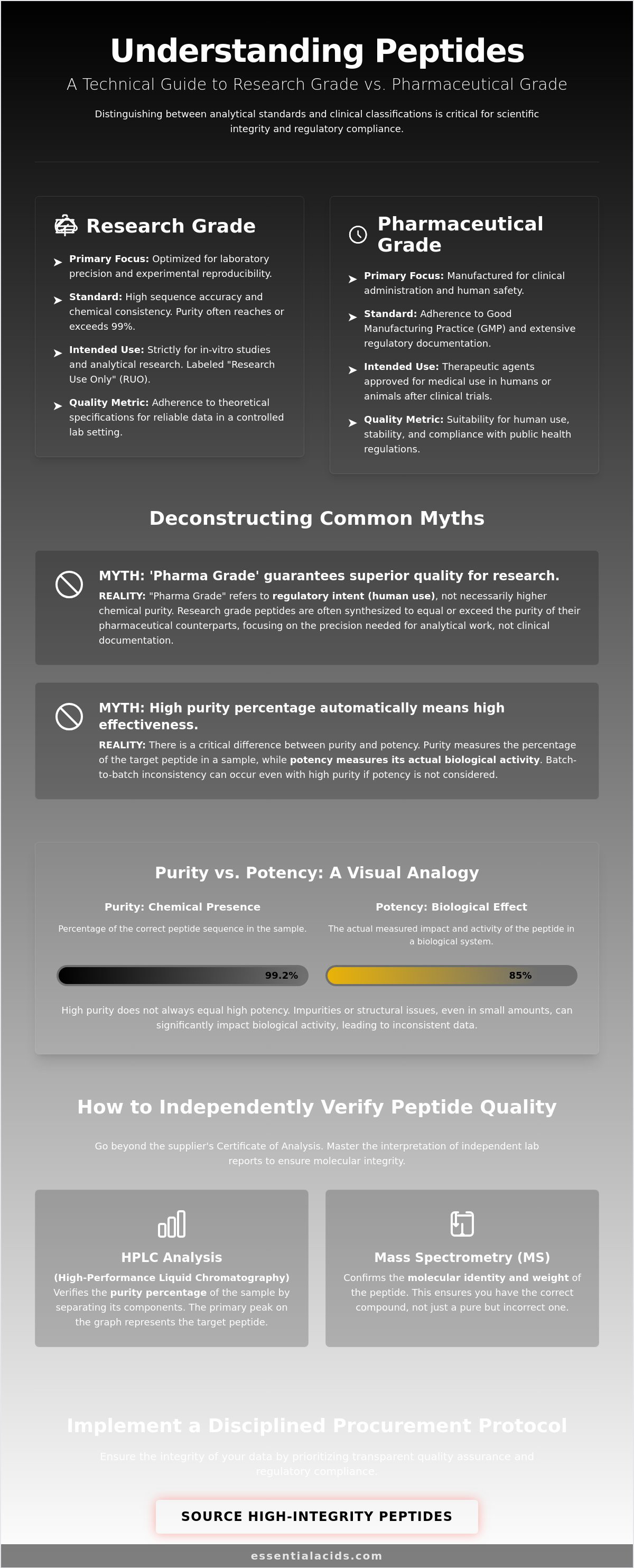
The assumption that pharmaceutical grade represents the absolute ceiling of chemical quality is a misconception that often complicates laboratory procurement. In the context of analytical biochemistry, the "pharma grade" label refers to a specific regulatory classification intended for human consumption rather than a superior chemical state. Pharmaceutical grade peptides are categorized by their specific regulatory oversight and clinical intent, requiring adherence to Good Manufacturing Practice (GMP) standards. While these standards are essential for clinical safety, they don't necessarily provide more precise data for an in vitro study or a metabolic research project. In fact, research grade peptides are frequently synthesized to meet or exceed the chemical purity levels of their pharmaceutical counterparts, often reaching 99% purity through rigorous purification processes.
Regulatory Intent vs. Chemical Purity
Pharmaceutical compliance focuses heavily on the documentation required for clinical trials and mass-market distribution. This includes extensive stability testing and administrative record-keeping that, while vital for public health, doesn't always translate to higher analytical resolution in the lab. Research grade materials prioritize batch-specific analytical data over this clinical compliance. This focus allows for greater flexibility in the early stages of laboratory discovery. However, the lack of centralized oversight in the research market means that some vendors provide materials with extensive variability in purity and abundance. This variability underscores why scientific integrity is maintained through independent verification rather than relying on a generic grade label. High-integrity research compounds are defined by their verified chemical identity, not by their intended clinical use.
The Cost of Compliance in Research
The "pharma" label carries a significant price premium driven by regulatory paperwork and facility certifications. For researchers focused on cellular signaling or protein interactions, these additional costs don't add analytical value to the study. Utilizing high-integrity research compounds allows laboratories to achieve cost-effective scientific scaling without compromising on the precision of their findings. By focusing on the chemical reality of the vial, researchers can allocate more resources toward data collection and analysis. Maintaining a professional distance from clinical labels ensures that the laboratory environment remains strictly objective and disciplined. To ensure your procurement aligns with these standards, it's essential to source compounds from suppliers who prioritize transparency and batch-specific verification. This commitment to accuracy is what allows researchers to move toward making better, normal through reliable, reproducible data.
Myth: High Purity Percentages Guarantee Successful Research Outcomes
A "99%" purity label on a vial of research grade peptides is an incomplete metric that can lead to significant experimental error if accepted at face value. While high purity is necessary for scientific integrity, it doesn't provide a comprehensive profile of the compound's chemical identity or its actual potency. Purity typically refers to the percentage of the target peptide relative to other peptide-related impurities, but it often ignores non-peptide residuals like salts, moisture, or solvents. For example, most peptides are synthesized using trifluoroacetic acid (TFA) as a counter-ion. If the TFA content is excessively high, it can negatively impact cellular response studies, even if the peptide itself is technically pure. Comprehensive peptide purity testing must account for these factors to ensure the validity of laboratory results.
Reading Between the Lines of an HPLC Report
High-Performance Liquid Chromatography (HPLC) is the standard for determining purity, but the headline percentage is only one part of the data. Each "peak" on the chromatogram represents a distinct chemical species. A singular, sharp peak indicates a high concentration of the target molecule, yet the baseline stability is equally revealing. A fluctuating baseline or numerous small "shoulders" around the main peak suggest the presence of degradation products or synthesis byproducts. Identifying these potential contaminants in research-grade materials is essential for maintaining a disciplined laboratory environment. Without stable baseline data, the reported purity percentage may be misleading, masking the presence of small-molecule impurities that can alter metabolic outcomes. Precision in interpreting these reports is what separates standard procurement from high-integrity research.
Molecular Identity Verification (MS)
Mass Spectrometry (MS) is the only method that confirms the molecular identity of the compound. While HPLC measures how "clean" a sample is, MS confirms that the sample is actually the intended sequence. It's possible to have a vial that is 99% pure but contains the wrong molecular structure due to a synthesis error or incorrect sequence mapping. MS verification provides the exact molecular weight of the peptide, serving as a linguistic and chemical filter for quality assurance. High-integrity procurement requires batch-specific analytical documentation that includes both HPLC and MS data for every vial. This level of transparency is fundamental to "Making better, normal" and ensures that the compounds used in your research are exactly what they're claimed to be. Relying on generic reports or headline numbers is a risk that serious researchers don't take. The quality of the compounds must speak for itself through verified, objective data.
Technical Procurement: Beyond the Certificate of Analysis
Procuring research grade peptides requires a technical understanding of product mass and physical state that extends beyond a simple purity percentage. Many researchers encounter confusion when the physical volume of lyophilised powder varies between vials of the same mass. This variation is often a result of the freeze-drying process and the specific salt content of the batch. Scientific integrity in the lab depends on your ability to calculate precise molar concentrations, which is impossible without distinguishing between different weight metrics. Professional procurement involves a disciplined approach to verifying the actual peptide content before beginning any metabolic or cellular study.
Understanding Net vs. Gross Peptide Weight
The mass stated on a vial label typically refers to one of two measurements: gross weight or net weight. Gross weight represents the total mass of the lyophilised powder in the vial. This includes the target peptide molecule along with counter-ions, such as acetate or trifluoroacetic acid (TFA), and residual water trapped during the synthesis process. In contrast, net weight refers only to the actual weight of the peptide molecule itself. It's common for a 5mg vial to contain only 4.2mg of 'net' peptide due to a 15% to 20% salt and moisture content. Failing to account for this difference can lead to significant under-dosing in an analytical environment, compromising the reproducibility of your data. High-integrity suppliers provide the peptide content percentage to allow for these critical adjustments.
Stability and Reconstitution Protocols
When you order peptides online, the compounds are typically delivered in a lyophilised state to maximize molecular stability. Lyophilisation serves a critical role in preserving peptide integrity for national shipping by removing moisture that would otherwise facilitate chemical degradation. However, the myth that all peptides remain stable at room temperature once reconstituted is a risk to laboratory precision. Most peptides begin to degrade rapidly once they are in a liquid state, requiring strict cold-chain management and refrigeration. In a professional lab setting, the choice between bacteriostatic water and sterile water is determined by the duration of the study. Bacteriostatic water, which contains 0.9% benzyl alcohol, is used to inhibit bacterial growth in multi-use vials, while sterile water is reserved for single-use applications where preservatives might interfere with cellular responses.
Maintaining these standards ensures that your research remains objective and free from the variables of improper handling. To maintain the highest level of precision in your laboratory, it's vital to source research materials from partners who understand the gravity of these technical distinctions. Making better, normal starts with the disciplined management of every compound from procurement to reconstitution.
Maintaining Scientific Integrity in Analytical Research
Maintaining scientific integrity in laboratory research is a continuous process that begins long before the first assay is performed. It requires a disciplined selection of research grade peptides based on objective data rather than commercial trends. As the regulatory environment shifts, the necessity for strict adherence to 'research-use only' protocols has never been more critical. This boundary ensures that laboratory work remains focused on the primary objective: the advancement of biochemical knowledge through reproducible data. A supplier’s commitment to transparency is the only reliable metric for assessing the quality of analytical materials. Without verifiable data, the risk of batch-to-batch inconsistency becomes an unacceptable variable in complex metabolic studies.
The Essential Acids Commitment
Essential Acids operates with a quiet authority, prioritizing the technical needs of the scientific community over traditional marketing flair. Every compound in our catalog, from BPC-157 to 5-Amino-1MQ, is selected for its high-purity profile and relevance to cellular and metabolic research. We provide batch-specific Certificates of Analysis (COAs) as a standard requirement for every order, not as an optional request. This ensures that researchers have immediate access to the HPLC and Mass Spectrometry data necessary for precise molar calculations and sequence verification. Our no-nonsense approach to laboratory supply reflects a deep commitment to the gravity of your work. We don't rely on aggressive sales tactics; instead, we expect the quality of our compounds to speak for itself through rigorous analytical verification.
Advancing Future Research Standards
Researchers must prioritize analytical data over marketing buzzwords to ensure the long-term viability of their studies. The professionalization of the research peptide industry depends on a collective adherence to high-integrity procurement standards. Before finalizing a procurement decision, consider the following technical checklist to ensure your materials meet professional laboratory requirements:
- Does the supplier provide batch-specific HPLC and MS reports for the current lot?
- Is the 'research-use only' designation clearly stated and respected in all documentation?
- Has the net peptide weight been verified to account for counter-ions and residual moisture?
- Are the storage and shipping protocols, including cold-chain management, optimized for molecular stability?
Adhering to these standards allows for a more stable and well-regulated laboratory operation. We invite you to view our catalog of high-purity research compounds to see how we support high-integrity studies. Our philosophy of 'Making better, normal' drives our pursuit of scientific progress, ensuring that the compounds you use are as precise as the data you collect. By choosing a partner that values transparency and regulatory compliance, you protect the integrity of your research and contribute to the advancement of modern biochemistry.
Advancing Laboratory Precision through Verified Procurement
The procurement of research grade peptides is an analytical discipline that requires a departure from marketing myths. Achieving scientific integrity depends on your ability to look past headline purity percentages and verify the chemical identity of your materials through batch-specific COAs. Understanding the technical distinction between gross and net weights, alongside the regulatory intent of research-use only labels, ensures that your experimental data remains objective and reproducible. High-purity analytical standards aren't a luxury; they're the foundation of credible cellular and metabolic research. Precision in the lab starts with precision in the vial.
We invite you to Explore our high-purity research compounds at Essential Acids. Each compound is specialized for metabolic and cellular research, backed by the verified data required to maintain professional laboratory standards. By prioritizing transparency and precision, you contribute to a more stable and high-integrity scientific landscape. We look forward to supporting your next breakthrough as we work toward making better, normal.
Frequently Asked Questions
Is research grade the same as pharmaceutical grade?
Research grade is not the same as pharmaceutical grade. While both classifications may share high chemical purity, pharmaceutical grade requires specific Good Manufacturing Practice (GMP) certifications and clinical documentation for human administration. Research grade materials are optimized for analytical precision in controlled laboratory environments. They are categorized as research-use only and lack the regulatory filings necessary for clinical use or human consumption.
Can research grade peptides be used for human consumption?
Research grade peptides cannot be used for human or veterinary consumption under any circumstances. These compounds are strictly synthesized for in vitro studies and laboratory experimentation. Distributing or using these materials for human use is a violation of regulatory standards and safety protocols. Scientific integrity requires a disciplined adherence to these boundaries to ensure research remains objective and compliant with legal frameworks.
How do I verify the purity of research grade peptides?
Purity verification requires the analysis of batch-specific High-Performance Liquid Chromatography (HPLC) and Mass Spectrometry (MS) reports. HPLC identifies the percentage of the target peptide relative to other peptide-related impurities. MS confirms the molecular identity by verifying the exact molecular weight of the sequence. Independent laboratory verification is the only reliable method to ensure the compounds meet the required analytical standards for your study.
What does 99% purity actually mean in a laboratory context?
In a laboratory context, 99% purity indicates that 99% of the peptide content in the vial matches the target sequence. It doesn't mean the vial is 99% peptide by total weight. The remaining 1% typically consists of peptide-related impurities. Non-peptide residuals, such as residual water or counter-ions like trifluoroacetic acid (TFA), are excluded from this percentage and must be accounted for separately during concentration calculations.
What happens if a peptide is stored at the wrong temperature?
Exposure to incorrect temperatures facilitates the rapid chemical degradation of the peptide chain. Lyophilised peptides are generally stable at room temperature for short durations during transit, but long-term storage requires refrigeration at 4°C or freezing at -20°C. Once reconstituted, peptides become significantly more volatile. Failure to maintain a strict cold chain results in the loss of molecular integrity, rendering the research grade peptides useless for precise analytical research.
Why do some research peptides require specific buffers for reconstitution?
Specific buffers are required when a peptide's isoelectric point affects its solubility in standard diluents like bacteriostatic water. Some research grade peptides are hydrophobic or require a specific pH range to dissolve completely without aggregating. Utilizing the correct buffer ensures a homogenous solution, which is vital for accurate delivery and consistent data. Always consult the technical data sheet for the specific solubility requirements of the compound before reconstitution.
Is a Certificate of Analysis (COA) enough to guarantee peptide quality?
A Certificate of Analysis is only a guarantee of quality if it is batch-specific and includes both HPLC and MS data. Generic or outdated COAs don't reflect the current lot's chemical reality. Researchers must verify that the report's date and lot number match the vial in their possession. High-integrity procurement relies on these documents to maintain scientific integrity and ensure that the compounds haven't been compromised by batch-to-batch inconsistency.
How does net peptide weight affect my laboratory dosage calculations?
Net peptide weight is the critical metric for calculating accurate molar concentrations. Because lyophilised powder includes counter-ions and residual moisture, the gross weight doesn't represent the actual mass of the peptide molecule. If a 5mg vial has an 80% peptide content, it only contains 4mg of the actual peptide. Ignoring this 20% variance results in inaccurate dosing and skewed experimental results during cellular or metabolic studies.
Legal Disclaimer
All products sold on this website are intended exclusively for laboratory research purposes and not for human or veterinary use, diagnosis, cure, treatment, or prevention of any disease or condition. None of the statements on this site have been reviewed or evaluated by the U.S. Food and Drug Administration (FDA) or comparable regulatory authorities. Purchasing or using these products for any unintended purpose, including human consumption, may violate federal or local laws and poses safety risks.