

Does the common misclassification of tb 500 as a mere synonym for Thymosin Beta-4 undermine the precision of your molecular assays? While both compounds are fundamental to regenerative biochemistry, this synthetic fragment possesses distinct actin-binding properties that require a specific analytical approach. It's recognized that researchers often struggle with inconsistent peptide purity and a lack of standardized reconstitution protocols, which can jeopardize the validity of cellular data and lead to laboratory errors.
This technical guide establishes a definitive molecular profile for the LKKTETQ sequence to ensure your laboratory work maintains the highest level of scientific integrity. You'll receive a rigorous comparison of the synthetic fragment versus the full-length protein, an update on the shifting regulatory landscape following the July 23, 2026 PCAC review, and a validated protocol for research-only applications. By prioritizing batch-specific transparency and precise handling techniques, you can differentiate your study through superior methodology and more reliable outcomes. We focus on the objective data necessary to move your research forward with professional confidence.
Key Takeaways
- Distinguish the 7-amino acid synthetic fragment from the full 43-amino acid Thymosin Beta-4 protein to ensure molecular precision in your assays.
- Master the specific G-actin binding and sequestration mechanisms that drive cellular responses and angiogenic research outcomes.
- Evaluate the systemic actin-binding properties of tb 500 alongside localized pathways like BPC-157 for comprehensive multi-peptide research.
- Establish rigorous laboratory protocols for reconstitution with BAC Water and long-term storage at -20°C to maintain peptide stability.
- Navigate the 2026 regulatory landscape by prioritizing batch-specific analytical transparency and high-purity sourcing for research-use only.
Understanding TB-500: The Molecular Profile of the Thymosin Beta-4 Fragment
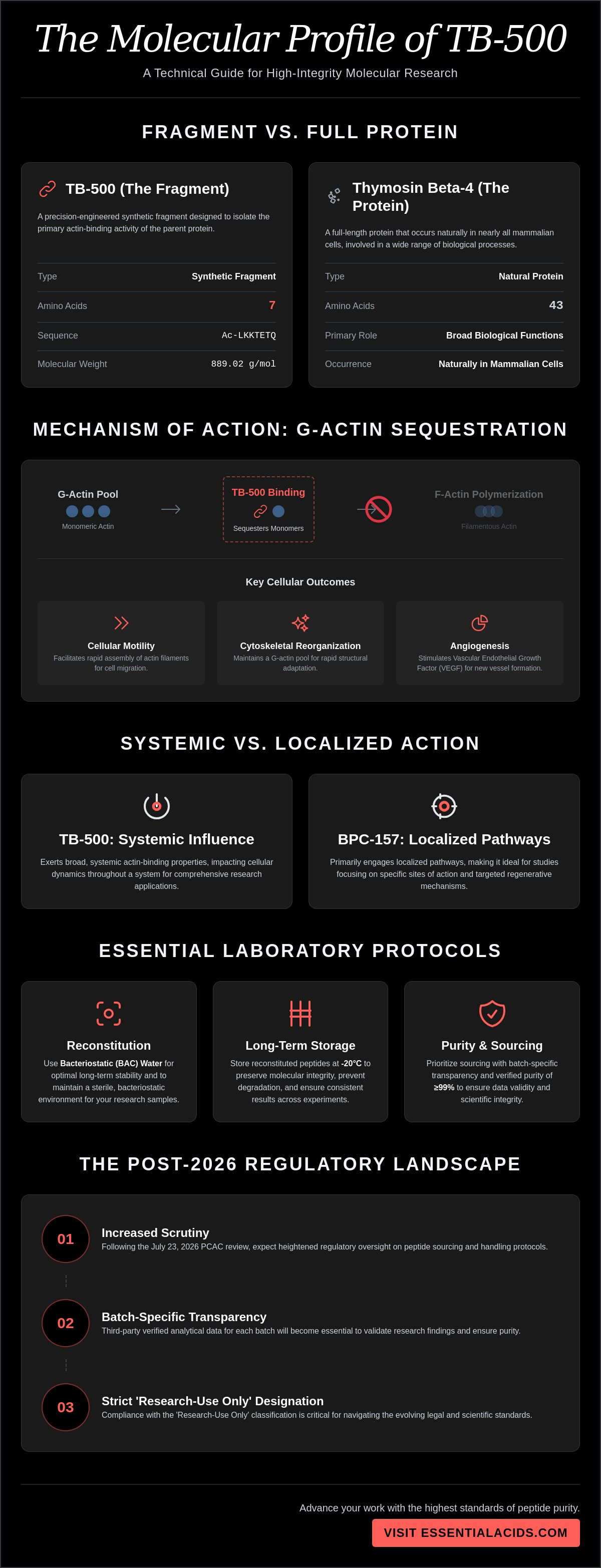
The compound tb 500 isn't the full-length Thymosin Beta-4 protein; it's a precision-engineered, synthetic N-terminal acetylated fragment. While many researchers use these terms interchangeably, scientific integrity requires a clear distinction between the two. A standard Thymosin Beta-4 Molecular Profile reveals a 43-amino acid protein that occurs naturally in nearly all mammalian cells. In contrast, the research peptide consists of a specific 7-amino acid sequence, Ac-LKKTETQ. This truncated version is synthesized to isolate the primary biological activity of the parent molecule, specifically its ability to bind to G-actin.
Identifying this fragment in a laboratory setting requires rigorous analytical verification. The chemical formula for the LKKTETQ fragment is C38H68N10O14. This molecular structure is designed to mimic the active site of the larger protein while allowing for easier synthesis and targeted cellular research. The sequence plays a critical role in actin sequestration, which is the process of preventing G-actin from polymerizing into F-actin. This interaction is fundamental to cellular migration and the formation of new vascular structures in vitro.
The Evolution of TB-500 in Laboratory Research
The history of this peptide began with the isolation of Thymosin Beta-4 from bovine thymus extracts in the late 20th century. Researchers soon discovered that the full 43-amino acid chain was not entirely necessary for its regenerative properties. By identifying the LKKTETQ domain as the functional core, synthetic chemists were able to produce the fragment more efficiently. Laboratories now prioritize this fragment for specific assays because it offers a more streamlined molecular profile for studying angiogenesis. As of June 2026, the standard for high-purity TB-500 in Australia requires third-party verified purity levels of 99% or higher, ensuring that batch-specific contaminants don't interfere with cellular data.
Chemical Structure and Stability
N-terminal acetylation is a defining characteristic of this peptide fragment. This modification isn't just a structural detail; it significantly impacts the peptide's half-life and resistance to enzymatic degradation in laboratory environments. The solubility profile of the compound is also a critical factor for successful assays. It demonstrates high solubility in aqueous solutions, though the choice of solvent affects long-term stability. While sterile water is often used for immediate applications, reconstitution with BAC Water is the preferred protocol for research requiring a bacteriostatic environment. The molecular weight of the LKKTETQ fragment is 889.02 g/mol. This precise weight allows for accurate molar calculations during the preparation of laboratory reagents.
Mechanism of Action: How TB-500 Influences Cellular Response
The primary mechanism of tb 500 involves the sequestration of G-actin (globular actin), which is the monomeric form of the most abundant protein in eukaryotic cells. By binding to these monomers, the peptide prevents their spontaneous polymerization into F-actin (filamentous actin). This process maintains a critical cytoplasmic pool of unpolymerized actin. It's this specific molecular interaction that allows for rapid cytoskeletal reorganization, a fundamental requirement for cellular motility and structural adaptation in research models.
Actin Sequestration and Cytoskeletal Dynamics
Maintaining the G-actin pool is essential for laboratories investigating the mechanics of tissue regeneration. During cellular migration, the cell must quickly assemble actin filaments at the leading edge to push the membrane forward. TB-500 facilitates this by ensuring that the building blocks of the cytoskeleton are readily available. This interaction isn't limited to actin alone; the peptide also influences other cytoskeletal proteins within the cellular scaffold. These dynamics are central to wound healing assays, where researchers observe the rate of keratinocyte and fibroblast migration across a controlled substrate.
Angiogenesis and Vascular Endothelial Growth
In vitro research shows that the peptide significantly influences the formation of new vascular structures. This is primarily achieved through the stimulation of vascular endothelial growth factor (VEGF) and the subsequent migration of endothelial cells. In controlled environments, this mechanism is used to study hypoxia-induced cellular responses, where oxygen deprivation triggers the need for increased vascularity. These observations are vital for neuroscience and metabolic health studies, as they provide data on how cellular networks maintain nutrient delivery under stress.
Beyond cytoskeletal changes, the peptide upregulates matrix-metalloproteinases (MMPs). These enzymes degrade the extracellular matrix, allowing cells to navigate through tissue barriers during the regenerative process. This enzymatic activity is often studied alongside a specific anti-fibrotic switch mechanism. By modulating collagen deposition and myofibroblast differentiation, researchers can analyze the balance between healthy tissue repair and excessive fibrosis. This research is critical for understanding how to manage scar tissue formation in various biological contexts. For those conducting these detailed cellular assays, utilizing verified TB-500 ensures that the observed biological responses are due to the peptide's purity rather than analytical noise.
TB-500 vs. BPC-157: A Comparative Molecular Analysis
Divergent molecular pathways define the research applications of tb 500 and BPC-157. While both compounds are investigated for their regenerative properties, they operate through distinct biological mechanisms. TB-500 functions primarily through systemic actin-binding, utilizing the G-actin monomer pool to facilitate cellular movement across various tissue types. In contrast, BPC-157 is a pentadecapeptide known for its extreme stability in gastric environments and its modulation of the nitric oxide pathway. Researchers often evaluate these differences to determine which peptide better suits their specific laboratory model. For a technical exploration of these differences, see BPC-157 vs TB-500: A Comparative Molecular Analysis for Laboratory Research.
Synergistic potential exists when these peptides are utilized in multi-peptide research protocols. Because they target different stages of the repair process, they don't compete for the same receptors. TB-500 addresses the structural requirements of the cytoskeleton, while BPC-157 influences regulatory growth factors and angiogenic signaling. This dual-pathway approach allows for a more comprehensive analysis of tissue response in complex in vitro assays. Metabolic stability remains a point of comparison; BPC-157 is inherently more resistant to enzymatic breakdown, whereas TB-500 requires precise N-terminal acetylation to extend its half-life within the cytosolic environment.
Targeted Pathways and Research Applications
Selection criteria for researchers often depend on the desired scope of the cellular response. TB-500 is the preferred choice for studying systemic cellular migration because actin is a ubiquitous protein found in almost all mammalian cells. This provides a broad foundation for Thymosin β4 Function and Application in various biological contexts. BPC-157 is frequently selected for localized research involving tendon, ligament, or gastric tissue. While both compounds demonstrate angiogenic potency, the mechanism through which they stimulate vascular endothelial growth differs, requiring researchers to choose their peptide based on the specific signaling cascade they intend to isolate.
Purity and Batch Consistency Standards
Analytical integrity is maintained through rigorous HPLC (High-Performance Liquid Chromatography) verification for both compounds. Inconsistent purity levels can lead to conflicting data in multi-peptide studies, making batch-specific documentation essential for research reproducibility. Essential Acids provides verified materials to ensure that laboratory results remain objective and untainted by contaminants. Comparative standards for research materials are further detailed in the BPC-157 5mg: Molecular Profile, which outlines the necessary analytical benchmarks for high-purity peptides in 2026. These protocols ensure that the gravity of the research is matched by the quality of the compounds used.
Laboratory Handling: Reconstitution and Storage Protocols
Storage of lyophilized tb 500 requires strict temperature control to preserve molecular integrity. For long-term stability, the freeze-dried powder must be maintained at -20°C. Short-term storage in a refrigerated environment between 2°C and 8°C is acceptable for limited durations, but exposure to room temperature leads to rapid degradation of the peptide bonds. Light sensitivity is an additional critical factor. Peptides should be stored in amber vials or within dark-room conditions to prevent photo-oxidation, which can alter the chemical profile of the compound and invalidate research results.
The reconstitution process must be performed with clinical precision to avoid mechanical stress. Sterile saline or BAC Water is introduced to the vial slowly. It's essential that the diluent is allowed to run down the side of the glass rather than being sprayed directly onto the peptide cake. Vigorous agitation or shaking will break the delicate molecular structure. Researchers should use a gentle swirling motion until the powder is fully dissolved. Once reconstituted, the peptide is significantly more fragile and should be utilized within a timeframe that aligns with its known stability profile in solution.
Reconstitution Best Practices for Researchers
Calculating the final concentration in mg/mL is necessary for accurate laboratory dosing. If a 5mg vial is reconstituted with 2mL of diluent, the resulting concentration is 2.5mg/mL. This procedural logic is consistent with standard laboratory techniques for synthetic fragments, as detailed in our BPC-157 Reconstitution: A Technical Guide. A successful reconstitution is indicated by a completely clear and colorless solution. Any cloudiness, precipitates, or visible particulates suggest either contamination or incomplete dissolution. Such samples must be discarded to maintain the scientific integrity of the assay.
Analytical Verification of Peptide Integrity
Mass Spectrometry (MS) reports provide the definitive verification of a peptide's identity and purity. When analyzing tb 500, the MS report should show a primary peak corresponding to the precise molecular weight of the Ac-LKKTETQ fragment. Common impurities in lower-grade synthesis often include truncated sequences or residual solvents from the manufacturing process. Essential Acids provides batch-specific certificates of analysis to ensure every research material meets the required analytical benchmarks. This transparency is vital for researchers who require absolute certainty in their molecular assays. To ensure your laboratory work is supported by verified compounds, you can source high-purity TB-500 directly from our analytical catalog.
Sourcing TB-500: Ensuring Scientific Integrity in 2026
The procurement of tb 500 for laboratory applications is governed by the strict "Research-Use Only" mandate. This isn't a mere legal formality; it's a foundational requirement for maintaining scientific integrity within the research community. Compounds intended for human consumption are subject to different regulatory pathways and manufacturing standards that don't align with the precision required for molecular assays. By adhering to a research-only distribution model, suppliers ensure that the chemical profile of the peptide remains focused on analytical purity rather than commercial palatability. Researchers must recognize that any supplier marketing these compounds for personal use is operating outside the boundaries of established scientific conduct.
Verifying supplier credentials requires a methodical review of analytical documentation before any procurement occurs. A reputable source doesn't just claim high purity; it proves it through accessible, batch-specific data. Before finalizing a purchase, researchers should demand current HPLC and Mass Spectrometry reports that match the specific lot number of the product. These documents act as a chemical fingerprint, confirming the identity of the Ac-LKKTETQ sequence and identifying any residual trifluoroacetic acid (TFA) or other synthesis byproducts. In an industry where "analytical grade" is often used loosely, the ability to cross-reference laboratory results with supplier claims is the only way to ensure the validity of your data.
The Essential Acids Quality Framework
Essential Acids operates as a specialized partner for Australian laboratories, providing high-purity TB-500 that meets the rigorous demands of 2026 research standards. Our framework is built on the philosophy of "Making better, normal," which drives us to prioritize scientific accuracy over market trends. We maintain a disciplined distribution policy that restricts access to verified research entities, ensuring our compounds are used solely for the advancement of biological knowledge. Every compound in our inventory undergoes batch-specific testing to guarantee that the molecular integrity of the peptide is preserved from synthesis to delivery.
Procurement and Next Steps for Researchers
Accessing technical documentation is a streamlined process designed to respect the professional focus of the research community. Batch-specific HPLC and MS reports are provided with every order, allowing for immediate integration into laboratory records. We understand that the physical fulfillment of these products is as critical as their chemical composition. Consequently, we utilize secure, temperature-controlled logistics to prevent thermal degradation during transit, ensuring the peptide arrives in its stable, lyophilized state. To view our full range of analytical-grade compounds and support your upcoming study, you may Explore the Essential Acids Research Catalog and review our latest technical specifications.
Advancing Molecular Research through Analytical Precision
Success in cellular assays depends on the rigorous application of molecular data and standardized handling protocols. By isolating the 7-amino acid active fragment from the parent protein, researchers can more accurately observe specific actin-binding dynamics and angiogenic responses. Maintaining these results requires strict adherence to -20°C storage and gentle reconstitution to prevent peptide degradation. High-integrity sourcing remains the final pillar of this process; analytical transparency ensures that experimental variables aren't introduced by low-grade synthesis or contaminants. When you prioritize verified purity, you uphold the core value of scientific integrity in your tb 500 studies.
Essential Acids supports the scientific community by providing batch-specific HPLC and Mass Spectrometry reports with every compound. Our materials are strictly manufactured for laboratory and analytical research, backed by a high-integrity Australian distribution network with secure fulfillment. Utilizing verified compounds allows you to focus on data acquisition with professional confidence. You can Order High-Purity TB-500 for Laboratory Research to ensure your next project is built on a foundation of reliability. We look forward to seeing the advancements your research brings to the field of regenerative biochemistry.
Frequently Asked Questions
What is the specific amino acid sequence of TB-500?
The specific amino acid sequence is Ac-LKKTETQ. This N-terminal acetylated fragment represents the active domain of the larger Thymosin Beta-4 protein. It's synthesized to isolate the actin-binding properties of the parent molecule, allowing researchers to study cellular migration with a more streamlined molecular profile.
Is TB-500 the same as Thymosin Beta-4?
No, these are distinct molecular entities. Thymosin Beta-4 is a full-length protein consisting of 43 amino acids that occurs naturally in mammalian cells. In contrast, TB-500 is a synthetic 7-amino acid fragment of that protein. While they share biological pathways, the fragment is preferred in laboratory settings for its targeted activity and ease of synthesis.
How should TB-500 be stored to maintain molecular stability?
Lyophilized powder must be stored at -20°C for long-term stability. Once the tb 500 is reconstituted, the solution should be kept refrigerated between 2°C and 8°C. It's also necessary to protect the vials from light exposure by using amber glass or storing them in a dark environment to prevent photo-oxidation.
What is the recommended reconstitution liquid for TB-500 research?
Bacteriostatic water (BAC Water) or sterile 0.9% saline are the standard diluents for laboratory reconstitution. BAC Water is generally preferred for research protocols that require multi-use vials because the benzyl alcohol prevents bacterial growth. The diluent should be introduced slowly and swirled gently to avoid damaging the peptide's structural integrity.
Can TB-500 be used in combination with BPC-157 in research models?
Yes, these compounds are frequently utilized together in multi-peptide research models. They operate through divergent biological pathways; tb 500 facilitates systemic actin-binding, while BPC-157 influences nitric oxide signaling and growth factor modulation. This combination allows researchers to analyze synergistic effects on tissue regeneration in vitro.
What are the signs of peptide degradation in a reconstituted solution?
A successful reconstitution results in a completely clear and colorless solution. Any visible signs of cloudiness, precipitation, or particulates indicate that the peptide has degraded or was improperly handled. Such samples shouldn't be used in assays, as degraded fragments will provide inaccurate analytical data.
Why is HPLC testing critical for TB-500 research compounds?
HPLC testing is the only way to verify the purity and chemical identity of the peptide batch. It ensures that the sequence is exactly Ac-LKKTETQ and detects any residual solvents or synthesis byproducts. This analytical verification is essential for scientific integrity, ensuring that laboratory results are due to the peptide itself rather than contaminants.
What is the regulatory status of TB-500 for laboratory research in 2026?
The compound is strictly for research-use only and isn't intended for human consumption or pharmaceutical use. In 2026, the regulatory landscape is shifting, with an FDA Pharmacy Compounding Advisory Committee review scheduled for July 23, 2026. Researchers must maintain a professional distance from non-compliant suppliers and adhere to all institutional safety and legal guidelines.
Legal Disclaimer
All products sold on this website are intended exclusively for laboratory research purposes and not for human or veterinary use, diagnosis, cure, treatment, or prevention of any disease or condition. None of the statements on this site have been reviewed or evaluated by the U.S. Food and Drug Administration (FDA) or comparable regulatory authorities. Purchasing or using these products for any unintended purpose, including human consumption, may violate federal or local laws and poses safety risks.