

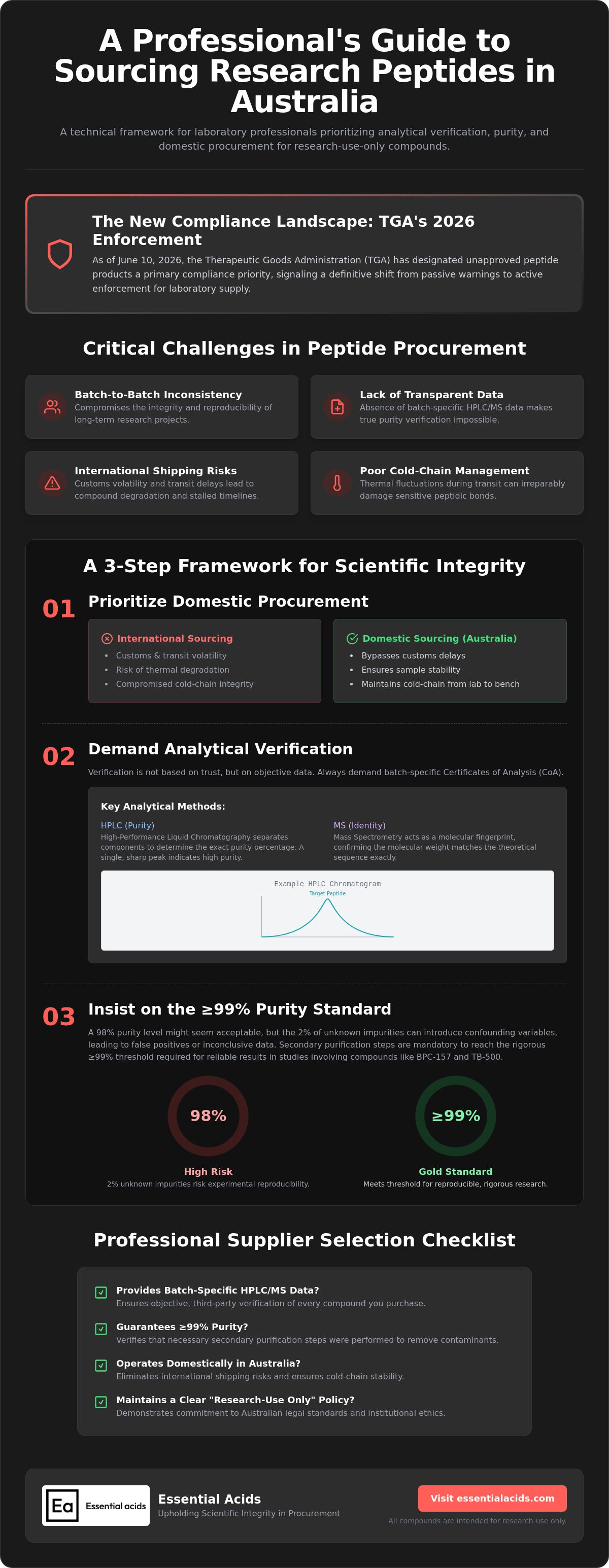
As of June 10, 2026, the Therapeutic Goods Administration (TGA) officially designated unapproved peptide products a primary compliance priority, signaling a definitive shift from passive warnings to active enforcement. For the laboratory professional, this heightened regulatory environment complicates the already difficult task of securing high-purity compounds. You likely find that batch-to-batch inconsistency and the absence of transparent HPLC/MS data often compromise the scientific integrity of your research. It's frustrating when international shipping delays or poor cold-chain management further stall your critical timelines.
This technical guide provides a rigorous framework to buy research peptides australia by prioritizing analytical verification over mere vendor trust. We'll outline how to secure ≥99% purity through batch-specific Certificates of Analysis (CoA) and domestic procurement strategies. By adhering to these standards, you ensure that every compound, intended strictly for research-use only, meets the precision required for metabolic or cellular ageing studies. We'll explore the logistics of reliable laboratory supply, the necessity of verified analytical data, and the importance of maintaining a professional distance from commercial trends to pursue the goal of making better, normal.
Key Takeaways
- Understand why domestic procurement is essential to bypass international customs volatility and prevent environmental degradation of sensitive compounds.
- Verify chemical purity by demanding batch-specific HPLC data when you buy research peptides australia for your laboratory applications.
- Identify the critical role of secondary purification steps in ensuring that compounds like BPC-157 and TB-500 meet rigorous purity thresholds of 99% or higher.
- Implement precise handling and reconstitution protocols, including the no-agitation rule, to preserve the structural integrity of delicate peptidic bonds.
- Establish a framework for selecting professional suppliers based on transparent analytical documentation rather than static website claims.
Navigating Research Peptide Procurement in Australia (2026)
Research-grade peptides are defined as high-purity sequences specifically synthesized for in-vitro and laboratory applications. These materials serve as critical reagents in biochemical assays and cellular models. When researchers look to buy research peptides australia, they must prioritize domestic procurement to ensure the stability of their samples. International transit often involves customs volatility and environmental stressors that cause rapid molecular degradation. Sourcing within Australia ensures that cold-chain integrity is maintained from the point of synthesis to the laboratory bench, protecting the compound from thermal fluctuations.
The 2026 landscape of Australian molecular biology research shows a distinct shift toward metabolic studies. Researchers are increasingly investigating compounds like 5-Amino-1MQ to understand intracellular signaling and enzymatic inhibition. As these studies scale, the need for consistent, high-purity material becomes paramount. It's vital to maintain a firm boundary: these compounds are intended for research-use only. This distinction isn't merely a legal disclaimer; it represents a commitment to scientific integrity. This disciplined approach to supply allows for the exploration of human potential through a rigorous lens, supporting the goal of making better, normal.
The Regulatory Landscape for Laboratory Compounds
The Australian framework for purchasing non-therapeutic research chemicals requires a clear distinction between clinical medicines and analytical reagents. Research-grade peptides are synthesized for laboratory use, not for administration to humans or animals. This differentiation is critical. Human-grade pharmaceuticals undergo different regulatory pathways and are intended for therapeutic intervention. In contrast, laboratory materials are evaluated based on their chemical purity and sequence accuracy. Suppliers must be transparent about their intended use policies to ensure all procurement aligns with Australian legal standards and institutional ethics.
Why Purity Levels Dictate Research Outcomes
In cellular response studies, the presence of even minor contaminants can lead to false positives or inconclusive data. A purity level of 98% might seem acceptable, but that 2% of unknown impurities represents a significant risk to experimental reproducibility. The process of chemical peptide synthesis is a complex, multi-stage procedure. It often results in truncated sequences or leftover reagents that must be removed. Secondary purification steps are required to reach the ≥99% threshold. Analytical verification, specifically through batch-specific HPLC and mass spectrometry, provides the objective proof of quality that rigorous research demands. Without this data, the integrity of the entire study is at risk.
Technical Standards for High-Purity Research Materials
The synthesis of research-grade peptides is a complex multi-stage process that requires rigorous oversight. For compounds like BPC-157 and TB-500, the initial solid-phase synthesis often produces a crude material containing truncated sequences and residual reagents. Secondary purification steps, typically involving preparative High-Performance Liquid Chromatography (HPLC), are mandatory to isolate the target sequence. This process ensures the compound reaches the ≥99% purity threshold necessary for experimental reproducibility. When researchers look to buy research peptides australia, they must verify that these secondary purification protocols were strictly followed to avoid confounding variables; those who wish to find out more about the technical profile of TB-500 can consult resources from Peptide Research AU.
High-Performance Liquid Chromatography serves as the primary analytical tool for determining chemical purity. By passing the peptide through a stationary phase under high pressure, individual components are separated based on their molecular interactions. A professional chromatogram will display a single, sharp peak representing the target compound. Mass Spectrometry (MS) complements this by confirming the molecular weight and identity of the peptide. It acts as a molecular fingerprint, ensuring the synthesized chain matches the theoretical sequence exactly. Adhering to TGA regulatory requirements necessitates a clear focus on these laboratory-only standards to maintain compliance and scientific integrity. For a comprehensive look at these procedures, read our professional guide to peptide purity testing.
Deciphering HPLC and Mass Spectrometry Reports
Interpreting analytical data requires an understanding of the chromatogram's structure. The purity of a batch is determined by the "area under the curve" (AUC) of the primary peak relative to the total area of all detected peaks. Any secondary peaks indicate the presence of impurities, such as residual solvents or failed sequences. Mass Spectrometry reports should show a dominant mass-to-charge ratio that aligns with the peptide's calculated molecular weight. If the MS data reveals unexpected peaks, it suggests the presence of contaminants that could compromise cellular response studies. Professional procurement relies on the ability to verify these batch-specific documents before the research begins.
The Role of Lyophilisation in Peptide Stability
Lyophilisation, or freeze-drying, is the essential process for ensuring long-term peptide stability. By removing moisture through sublimation in a vacuum, the compound is transitioned into a stable solid state. This prevents hydrolysis and enzymatic degradation, which are the primary causes of peptide failure during storage. A high-quality lyophilised product should appear as a uniform, porous "cake" within the vial. A collapsed or gummy appearance often indicates moisture ingress or a failure in the freeze-drying cycle, both of which suggest compromised integrity. Researchers should prioritize verified research compounds that demonstrate consistent lyophilisation quality to ensure the longevity of their laboratory reagents.
Criteria for Selecting a Professional Peptide Supplier
Selecting a supplier to buy research peptides australia requires a transition from accepting marketing claims to demanding analytical proof. A professional supplier acts as a gatekeeper of scientific integrity. They don't rely on static website imagery or generic descriptions. Instead, they provide direct access to the raw data for every batch. This includes both HPLC chromatograms and Mass Spectrometry reports that correspond to the specific vial number in your possession. A comprehensive catalog featuring metabolic research compounds like Ipamorelin and CJC-1295 is a secondary consideration to the transparency of the data supporting those items. The quality of the compounds must speak for itself through verified documentation.
The presence of a professional policy structure is a key indicator of a reliable partner. Ethical suppliers maintain a strict research-use only boundary and avoid the aggressive sales tactics common in the broader e-commerce market. This disciplined approach ensures that the focus remains on the precision of the laboratory rather than commercial trends. By prioritizing suppliers who adhere to these rigorous standards, researchers support the broader goal of making better, normal through high-integrity data.
Verifying Batch-Specific Analytical Documentation
A typical Certificate of Analysis (CoA) is often insufficient for rigorous research. These documents are frequently recycled or represent a representative sample rather than the current inventory. Red flags include obscured dates, mismatched batch numbers, or low-resolution scans that suggest digital manipulation. To maintain the integrity of your study, you should order peptides online only from sources that facilitate independent verification of their analytical data. If a supplier cannot provide the specific HPLC/MS data for the compound being dispatched, the risk of sequence errors or impurities becomes unacceptably high. Scientific integrity depends on the absolute certainty of the reagent's composition.
Supply Chain Transparency and Local Logistics
The logistics of peptide procurement are as critical as the synthesis itself. International drop-shipping introduces variables that are often outside the researcher's control. Prolonged transit times and lack of temperature oversight can lead to the rapid degradation of sensitive sequences. For example, GHK-Cu is particularly susceptible to environmental stress during shipping. Domestic warehousing in Australia provides a necessary layer of protection. Local logistics allow for secure, temperature-controlled storage and rapid dispatch. This reduces the window for molecular breakdown. Given the current TGA compliance on unapproved peptides, sourcing from an established Australian entity with transparent supply chains is the most effective way to ensure both regulatory adherence and compound stability. Integrity is maintained when the provenance of the research material is clear and verifiable.
Laboratory Handling and Reconstitution Protocols
The transition of a research compound from a stable, lyophilised state to an active aqueous solution requires precise laboratory control. When researchers buy research peptides australia, the preservation of the compound's structural integrity depends entirely on post-procurement handling. Peptides are inherently fragile molecules. Their secondary and tertiary structures are susceptible to mechanical shearing and thermal degradation. A strict no-agitation rule must be enforced during the preparation phase. Vigorous shaking or vortexing can break the delicate peptidic bonds, rendering the compound biologically inactive and compromising the validity of the research data.
Bacteriostatic (BAC) Water is the standard reagent for preparing multi-use research vials. The inclusion of 0.9% benzyl alcohol acts as a preservative, inhibiting the growth of potential contaminants during the research window. For advanced handling techniques and a deeper understanding of molecular stability, refer to the peptide synthesis and molecular biology guide. Maintaining a sterile environment and using calibrated equipment are non-negotiable requirements for ensuring experimental reproducibility.
Cold-Chain Integrity and Storage Requirements
Lyophilised peptides must be stored under specific thermal conditions to prevent degradation. For short-term storage of less than three months, a temperature of -20°C is generally sufficient. Long-term storage requires a controlled environment of -80°C to maintain molecular stability over several years. Repetitive freeze-thaw cycles must be avoided at all costs. These cycles facilitate the formation of ice crystals that can physically damage the peptide sequence. The use of desiccant packs within the storage container is advised to prevent moisture ingress. Even trace amounts of humidity can trigger hydrolysis, leading to the rapid breakdown of the lyophilised cake.
Precision Reconstitution for Analytical Accuracy
Determining the correct concentration is a fundamental step in laboratory protocol. The calculation is straightforward: divide the total milligrams of the peptide by the volume of the diluent in milliliters. For example, 5mg of a compound reconstituted with 2mL of BAC Water results in a concentration of 2.5mg/mL. When introducing the diluent, the needle should be aimed at the side of the glass vial. Allow the liquid to be drawn in slowly by the vial's internal vacuum pressure. This technique prevents foaming, which is a visual indicator of protein denaturing. Once reconstituted, most peptides have a stability window of 7 to 14 days when refrigerated at 2°C to 8°C. Beyond this period, the risk of potency loss increases significantly.
Ensure your laboratory is equipped with the highest quality reagents by sourcing analytical-grade research peptides for your upcoming metabolic studies.
Essential Acids: Upholding Scientific Integrity in Procurement
The philosophy of Essential Acids is defined by the signature objective: Making better, normal. This aspirational target is not a marketing slogan; it's a disciplined commitment to providing the biochemical precision required for visionary research. When professionals choose to buy research peptides australia, they require a partner that functions as a rigorous scientific gatekeeper. Our role is to filter the global supply chain, ensuring that only high-purity compounds enter the Australian laboratory environment. Every vial of 5-Amino-1MQ or other metabolic research tools we supply is backed by a commitment to scientific integrity. This professional distance ensures that the quality of the compounds speaks for itself, without the need for aggressive sales tactics.
We prioritize the gravity of laboratory research by maintaining a strict research-use only policy across all categories. This boundary is essential for regulatory compliance and professional transparency. By providing batch-specific analytical documentation, we empower researchers to focus on the precision of their metabolic and cellular ageing studies. Our catalog is curated for the serious investigator who demands verified data over commercial trends. This approach establishes Essential Acids as a reliable and ethical partner in the pursuit of scientific discovery.
Our Analytical Verification Process
Internal standards for purity at Essential Acids are absolute. A zero-tolerance policy is maintained for sub-standard batches. If a compound fails to meet the ≥99% purity threshold during independent testing, the entire batch is rejected. We maintain strategic relationships with independent testing laboratories to ensure all analytical data is objective and verifiable. This "research-grade" promise is the cornerstone of our authority within the biochemistry and neuroscience communities. We don't just supply compounds; we provide the analytical certainty required for experimental reproducibility. Every HPLC chromatogram and Mass Spectrometry report is a testament to this rigorous quality control process.
Transitioning from Procurement to Research
Establishing a professional procurement account is a streamlined process designed for the focused researcher. We provide a utilitarian flow from broad scientific categories to specific product data, respecting your time and professional focus. Beyond the digital storefront, technical support is available for researchers who require assistance in interpreting complex HPLC/MS data. If questions arise regarding a specific molecular fingerprint or purity peak, our responses are rooted in biochemistry and legal compliance. It's time to elevate the standards of laboratory supply in the domestic market. Understanding the nuances of research grade peptides is essential for any laboratory operating in 2026. We invite you to explore our verified catalog and experience a procurement process defined by expertise, caution, and a firm adherence to rules.
Advancing Scientific Integrity in Laboratory Procurement
The shift from vendor trust to analytical verification represents the modern standard for laboratory procurement. Successful research in 2026 depends on the absolute certainty of chemical purity and sequence integrity. By prioritizing domestic sourcing and demanding batch-specific HPLC and Mass Spec documentation, researchers mitigate the risks of molecular degradation and customs volatility. Adhering to strict research-only regulatory standards ensures that the focus remains on the precision of metabolic and cellular ageing studies rather than commercial trends.
Explore our catalog of high-purity research compounds to secure verified reagents for your next analytical application. We look forward to supporting your pursuit of scientific excellence with compounds that meet the highest technical standards.
Frequently Asked Questions
Is it legal to buy research peptides in Australia?
It's legal to purchase these compounds in Australia when they're intended strictly for laboratory and in-vitro research. The Therapeutic Goods Administration (TGA) maintains clear distinctions between therapeutic medicines and analytical reagents. While unapproved peptides are a compliance priority for 2026, sourcing high-purity materials for scientific inquiry remains a standard practice. Researchers must ensure their procurement aligns with institutional ethics and state poisons schedules to maintain full regulatory adherence.
How can I verify the purity of the peptides I purchase?
Purity is verified through High-Performance Liquid Chromatography (HPLC) and Mass Spectrometry (MS). When you buy research peptides australia, you should demand batch-specific reports rather than generic certificates. The HPLC chromatogram should show a single primary peak with an "area under the curve" (AUC) of at least 99%. MS data confirms the molecular weight matches the theoretical sequence, ensuring no truncated chains or residual solvents are present in the sample.
What is the difference between research-grade and pharmaceutical-grade peptides?
The primary difference lies in the regulatory pathway and intended application. Pharmaceutical-grade peptides are manufactured under Good Manufacturing Practice (GMP) standards for human clinical use. Research-grade peptides are synthesized for analytical and laboratory applications. While both require high purity, research-grade materials aren't intended for administration to humans or animals. They're labeled strictly for research-use only to maintain scientific integrity and follow the goal of making better, normal.
How should I store my peptides once they arrive?
Lyophilised peptides should be stored in a temperature-controlled environment to prevent molecular degradation. For short-term use, a standard laboratory freezer at -20°C is sufficient. Long-term storage requires -80°C to ensure sequence stability over several years. Vials must remain sealed with desiccant packs to avoid moisture ingress. Once reconstituted in Bacteriostatic Water, the solution should be refrigerated at 2°C to 8°C and used within its specific stability window.
Do you provide Certificates of Analysis (CoA) for every batch?
Yes, batch-specific analytical documentation is provided for every research compound. This includes the HPLC chromatogram and Mass Spectrometry report that corresponds directly to the vial being dispatched. We prioritize transparency and scientific integrity by ensuring researchers have access to the raw data required for experimental reproducibility. This practice filters for quality and ensures that every reagent meets the high-purity standards of our analytical verification process.
What happens if a peptide degrades during shipping?
Domestic shipping within Australia is managed through secure, temperature-controlled logistics to minimize the risk of thermal degradation. Lyophilised peptides are inherently more stable than aqueous solutions, but environmental stressors during transit can still affect structural integrity. If a shipment is delayed or exposed to extreme conditions, the compound's purity should be re-verified through analytical testing. Our supply chain is designed to maintain cold-chain integrity from synthesis to laboratory.
Can research peptides be used for human consumption?
No, research peptides are never intended for human consumption or clinical use. These materials are synthesized exclusively for laboratory research and in-vitro applications. The "research-use only" designation is a fundamental boundary that we maintain to uphold scientific integrity and regulatory compliance. It's vital to recognize that these compounds haven't been approved for therapeutic intervention. Any application outside a controlled scientific environment is strictly prohibited and violates our core safety policies.
What is the typical lead time for domestic shipping within Australia?
Domestic shipping typically ranges from 1 to 3 business days depending on the laboratory's location. When you buy research peptides australia from a domestic source, you avoid the customs volatility and prolonged transit times associated with international procurement. Rapid dispatch ensures that sensitive sequences aren't exposed to unnecessary environmental stress. This efficiency is critical for maintaining research timelines and ensuring that compounds arrive in a stable, lyophilised state for immediate application.
Legal Disclaimer
All products sold on this website are intended exclusively for laboratory research purposes and not for human or veterinary use, diagnosis, cure, treatment, or prevention of any disease or condition. None of the statements on this site have been reviewed or evaluated by the U.S. Food and Drug Administration (FDA) or comparable regulatory authorities. Purchasing or using these products for any unintended purpose, including human consumption, may violate federal or local laws and poses safety risks.